本研究探讨了电针(EA)对高盐诱导的血管功能障碍的影响。电针逆转了血管损伤和肠道菌群失调,其机制可能与调节特定肠道微生物有关。
研究文章
电针调控肠道菌群重塑:缓解高盐诱导血管病变的重要进展
* These authors contributed equally
在新标签页中打开
本文内容
摘要
Loading...
$$\rightleftharpoonup{xx}$$
$$\longleftharp{xx}$$,
$$\longrightharp{xx}$$,
摘要
Loading...
$$\rightleftharpoonup{xx}$$
$$\longleftharp{xx}$$,
$$\longrightharp{xx}$$,
本研究旨在探讨电针(EA)在缓解高盐饮食引起的血管功能障碍方面的治疗潜力及其作用机制,重点关注肠道菌群的调节作用。将21只大鼠随机分为正常对照组、高盐模型组和电针干预组(每组n = 7)。通过向Wistar大鼠灌胃12% NaCl建立"高盐血瘀证"模型。治疗在北京时间17:00至19:00之间进行:大鼠用软布固定后,在BL23和KI3穴位接受20分钟的电针刺激。实验结束后采集大鼠血液、血管组织及粪便样本。通过凝血功能检测、血液流变学分析和动脉组织病理学评估来评价血管功能变化。采用16S rDNA测序技术分析肠道菌群组成及丰度变化。研究结果表明,长期高盐摄入可导致血液黏度异常、血管内皮完整性受损以及肠道菌群失调。值得注意的是,电针治疗有效逆转了上述病理改变。相关性分析进一步发现特定肠道菌群(如Lachnospiraceae和Ruminococcaceae)与血液黏度参数的改变存在显著相关性(P < 0.05)。因此,本研究得出结论:高盐饮食诱导的血管病变可通过电针治疗得以逆转,其机制可能与电针调节参与胆汁酸代谢和短链脂肪酸合成的肠道菌群有关。
引言
Loading...
$$\rightleftharpoonup{xx}$$
$$\longleftharp{xx}$$,
$$\longrightharp{xx}$$,
膳食盐在维持体液平衡和细胞稳态中起着关键作用,但过量摄入已被明确认定为心血管和脑血管疾病的危险因素1。世界卫生组织建议健康成年人每日钠摄入量应限制在5克以下2。研究表明,高盐饮食(HSD)会损害血管功能,而作为全球最常见疾病的 cardiovascular disease(CVD),常伴随血管病变3。这些发现强调,修复高盐饮食引起的血管内皮损伤是预防CVD进展的关键策略。“血瘀证”(表现为血液循环不畅和体内血液瘀积)与现代医学中可量化的凝血功能障碍相对应。关键的验证生物标志物包括显著缩短的凝血酶原时间(PT)和活化部分凝血活酶时间(APTT),以及明显升高的纤维蛋白原(FIB)和凝血酶时间(TT)。这些指标反映了一种高凝状态,直接对应于血瘀的病理特征。
定植于整个胃肠道的肠道微生物群是免疫代谢过程和肠道稳态的关键调节因子,同时影响多种生理与病理通路4。新兴证据表明,过量摄入食盐可诱导肠道菌群失调和营养失衡,触发促炎性免疫活化,表现为局部炎症,并促进微循环损伤、血管重塑以及全身性内皮功能障碍1,5。已有研究报道,长期高盐饮食(HSD)可导致小鼠体内Bacteroides intestinalis、Aspergillus和Prevotella spp.的相对水平升高,并与高血压及血管炎症的发生发展相关6。
针灸作为中医(TCM)的核心组成部分,在临床实践中通过在特定穴位进行精确的针刺,被用作一种基于证据的补充和替代疗法。美国国立卫生研究院(NIH)和世界卫生组织(WHO)均认可针灸为多种病理状况下经过临床验证的干预手段。新兴证据表明,针灸具有双重治疗机制7,8,既能调节肠道菌群组成,又能抑制血管炎症介质,从而共同减缓相关疾病的病理进展。尤为重要的是,针灸在降低血压以及恢复受损血管的内皮功能方面具有显著疗效9。
选择电针(EA)而非手工针刺,是因为其具有标准化和可量化的刺激参数,能够减少操作者依赖的变异性,提高实验结果的可重复性。因此,我们研究了电针治疗对高盐血瘀证(HSBS)模型大鼠肠道菌群的影响,并通过血液流变学及血管组织病理学改变,评估电针对高盐诱导的血管病变的疗效。为进一步理解肠道菌群在电针改善血管病变中的作用,我们对肠道菌群中不同属的丰度与全血切变率及血沉进行了相关性分析。
因此,我们提出假设:电针通过恢复肠道微生物群稳态,缓解高盐饮食诱导的血管病变。为验证这一假设,我们的研究目标是:(i)量化电针对血管功能和结构的保护作用;(ii)鉴定电针调控的特定肠道微生物类群,并分析其与上述改善之间的相关性。此外,通过皮尔逊相关性分析,我们发现了肠道微生物群与血管指标之间显著的相关关系,尤其是差异富集的属级分类群的波动与血液流变学异常之间的关联。据我们所知,本研究是首次从肠道微生物群的角度探讨电针改善高盐饮食诱导血管病变保护机制的研究。本研究的实验设计如图1所示。
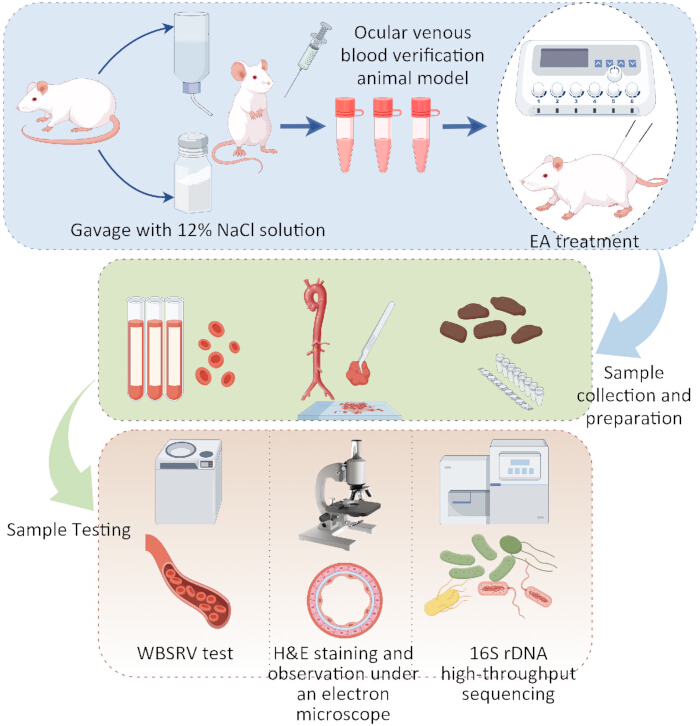
图1:实验技术示意图。 请点击此处查看此图的放大版本。
访问受限。请登录或开始试用以查看此内容。
方案
Loading...
$$\rightleftharpoonup{xx}$$
$$\longleftharp{xx}$$,
$$\longrightharp{xx}$$,
整个实验在成都中医药大学基础医学院实验中心进行。所有动物福利和实验程序均经成都中医药大学实验动物福利伦理委员会批准(伦理编号:2024078)。实验严格遵循《美国国立卫生研究院实验动物护理和使用指南》(1986年修订版,出版物86-23)的规定执行。
动物与饮食
6至8周龄、体重为200 ± 20 g的雄性和雌性无特定病原体(SPF)Wistar大鼠。所有大鼠均饲养于通风良好的房间内,保持12小时光照-黑暗循环,并可自由摄食和饮水。
模型与分组
动物模型的建立参考既往研究经验10。经过7天的适应性饲养后,将21只Wistar大鼠(雌雄各占50%)使用Excel中的随机数生成器随机分为三个实验组(每组n = 7),每组中雌雄大鼠数量大致均衡,以尽量减少性别对实验结果的影响11。正常对照组(NC):每日给予灌胃纯净水(1 mL/100 g)。高盐模型组(HS)和电针干预组(EA):每日灌胃给予12% NaCl溶液(1 mL/100 g)。所有干预持续30天,每日连续进行。
电针治疗
治疗于成功造模后的次日开始。选择电针而非手工针刺,因其具有标准化和可量化的刺激参数,可减少操作者依赖性带来的变异,提高实验结果的可重复性。膀胱经穴BL23(肾俞)和肾经穴KI3(太溪)的定位依据中国针灸学会制定的大鼠穴位定位标准12。BL23位于背中线旁开6 mm,第二腰椎棘突下缘水平。KI3位于内踝最高点与跟腱后缘之间凹陷的中点处。穴位局部毛发去除并消毒。使用一次性无菌针灸针(0.18 mm × 13 mm)垂直刺入穴位,BL23进针深度为4–6 mm,KI3进针深度为3–5 mm。电针仪的正极夹连接同侧BL23穴位针柄,负极夹连接同侧KI3穴位针柄。电针仪参数设置如下:波形:疏密波(10/50 Hz);时序:疏波持续5 s,密波持续10 s;刺激强度:1–2 mA,根据大鼠出现抽搐或疼痛反应(如尖叫、抗拒行为)进行调整;脉冲宽度:≤ 1 MS。刺激方案:每日干预一次,北京时间17:00至19:00之间进行,每次持续20分钟。疗程安排:每7天为一个治疗周期,共进行4个周期,每周期之间休息1天。具体流程见图2(由BioGDP.com13制作)。
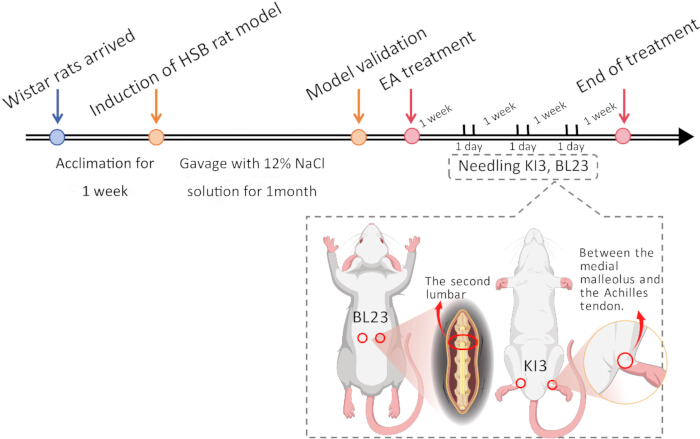
图2:实验时间线。请点击此处查看该图的放大版本。
样本采集与制备
灌胃给药一个月后,在电针干预前采集大鼠眶静脉血。血浆样本在 4 °C 条件下以 1,000 × g 离心 15 分钟提取。治疗结束后,收集各组大鼠的新鲜粪便。大鼠使用 10% 乳化异氟烷(30 mg/kg)麻醉后处死。打开腹腔,从腹主动脉采集约 5 mL 血液,用于 4 小时内测定全血切变率黏度(WBSRV)。采集腹主动脉组织用于组织病理学分析。所有样本均储存于 -80 °C,以备后续使用。
全血稳态粘度比值(WBSRV)检测
建模完成后,使用采血针从大鼠腹主动脉采集约 4-5 mL 全血,并置于肝素钠抗凝管中。轻轻摇动试管,确保血液样本与抗凝剂充分混合。在 4 小时内,使用全自动血液流变学分析仪测定全血稳态粘度比值(WBSRV)和红细胞沉降率(ESR)。
血管组织病理学
血管组织用4%多聚甲醛溶液固定至少24小时,切片厚度为3 µm,进行苏木精-伊红(HE)染色。图像在100×和400×放大倍数下采集。
16S rDNA 测序
从各组粪便样本中提取基因组 DNA。使用 V3-V4 区引物序列(341F:5'-CCTACGGGNGGCWGCAG-3';805R:5'-GACTACHVGGGTATCTAATCC-3')对总 DNA 进行 PCR 扩增。PCR 扩增程序如下:98 °C 预变性 30 秒,98 °C 变性 10 秒,54 °C 退火 30 秒,72 °C 延伸 45 秒,共 32 个循环,最后在 72 °C 延伸 10 分钟。对 PCR 产物进行纯化和定量。在 NovaSeq 6000 测序平台进行双端测序(2×250 bp)。将双端测序读长进行合并和过滤,以获得高质量数据。利用 QIIME 2 中的 DADA2 插件进行长度筛选和去噪处理。该过程生成扩增子序列变体(ASVs)及 ASV 丰度表,随后去除单次出现的 ASVs。基于 ASV 序列文件,使用 SILVA 数据库进行分类学注释和丰度分析,以探究各样本间的物种差异和群落组成。通过 α-多样性与 β-多样性分析评估物种多样性和相对丰度的变化,并在本平台(https://www.omicstudio.cn/home)进行数据可视化。
统计学分析
采用 SPSS 26.0 软件进行统计学分析。P < 0.05 被认为具有统计学显著性。对于方差齐性的数据,组间比较采用单因素方差分析(one-way ANOVA),若发现显著差异,则进一步进行事后最小显著性差异(LSD)检验。对于方差非齐性的数据,采用非参数的Kruskal-Wallis秩和检验(单因素方差分析)。采用Mann-Whitney U检验分析肠道微生物群组成及群落结构的变化。采用Pearson秩相关分析评估差异富集的肠道细菌与其他指标之间的相关性。之所以选用Pearson相关分析,是因为数据符合正态性和线性假设,该假设经Shapiro-Wilk检验和Durbin-Watson检验验证。统计图表和热图使用GraphPad Prism 10生成。
访问受限。请登录或开始试用以查看此内容。
结果
Loading...
$$\rightleftharpoonup{xx}$$
$$\longleftharp{xx}$$,
$$\longrightharp{xx}$$,
动物模型的验证
四项凝血参数在血管病变研究中具有关键作用,通过密切监测与血管病理变化密切相关的凝血功能异常。建模后经眼眶后静脉丛采血检测显示,高脂饮食/过量酒精组(HS/EA组)与正常对照组(NC组)之间的凝血参数(PT、APTT、FIB、TT)存在显著差异(图3)。具体检测数值见补充表1。这表明高脂饮食可能诱导大鼠出现凝血功能异常。
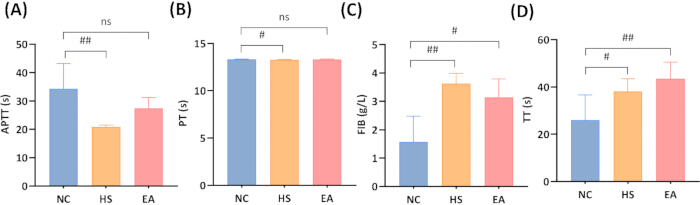
图3:凝血功能检测结果。
访问受限。请登录或开始试用以查看此内容。
讨论
Loading...
$$\rightleftharpoonup{xx}$$
$$\longleftharp{xx}$$,
$$\longrightharp{xx}$$,
血管病变是多种心血管疾病(CVD)和代谢紊乱发生及病理表现的关键因素。其有害影响包括血管功能障碍、异常血液凝固、脂质沉积和斑块形成,这些可导致血压升高、血栓形成以及动脉斑块发展,最终引发多种心血管疾病14,15,16。因此,及时干预以阻止血管病变进展并恢复正常的血管功能,对于预防和缓解心血管疾病及其他相关病症至关重要。
过量摄入盐是导致血管病变的原因之一。目前的研究表明,盐可通过多种途径引起水和钠潴留以及血管收缩17,18。高盐摄入还会破坏肠道菌群结构,促进炎性因子释放,间接加剧血管炎症19。根据中医理论,"盐入肾","肾主水液代谢"。适量摄入盐有助于肾气,促进水液代谢;而过量摄入盐则会扰乱水液代谢,导...
访问受限。请登录或开始试用以查看此内容。
披露
Loading...
$$\rightleftharpoonup{xx}$$
$$\longleftharp{xx}$$,
$$\longrightharp{xx}$$,
作者声明无利益冲突。
致谢
Loading...
$$\rightleftharpoonup{xx}$$
$$\longleftharp{xx}$$,
$$\longrightharp{xx}$$,
本研究由四川省科学技术厅(项目编号:2024NSFSC0717)资助。感谢Figdraw在图表绘制方面提供的协助。
访问受限。请登录或开始试用以查看此内容。
材料
| 姓名 | 公司 | 目录编号 | 评论 |
|---|---|---|---|
| 针灸针 | Suzhou Medical Supplies Factory Co., Ltd. | 242059 | 0.18 × 13 mm |
| 活化部分凝血活酶时间(APTT)检测试剂盒(凝固法) | 北京赛克赛斯科技有限公司 | R21D24C4 | |
| AMPure XP 磁珠 | Beckman Coulter Genomics | A63881 | |
| 全自动凝血分析仪 | 北京赛克赛斯科技有限公司 | SF-8050 | |
| 纤维蛋白原(FIB)检测试剂盒(凝固法) | 北京赛克赛斯科技有限公司 | R31D24D2 | |
| 全自动血液流变仪 | 北京赛克赛斯科技有限公司 | SA-5600 | |
| GraphPad Prism 10 | GraphPad Software, Inc. | ||
| 苏木精-伊红(H&E)染色液 | 武汉赛维尔生物科技有限公司 | G1005 | |
| Illumina 文库定量试剂盒 | Kapa Biosciences | 7960166001 | |
| 异氟烷 | RWD Life Science | R510-22-10 | 100 mL |
| 基于磁珠的粪便基因组DNA提取试剂盒 | Biotek | AU46111-96 | |
| Nikon Eclipse Ci-L 正置白光显微镜 | Nikon | ||
| QIIME 2 | https://qiime2.org/ | ||
| SDZ-II 华佗电子针疗仪 | Suzhou Medical Supplies Factory Co., Ltd. | SDZ-II | |
| SILVA 数据库 | Release 138, https://www.arb-silva.de/ | ||
| 氯化钠 | 成都金山化学试剂有限公司 | 20231008 | 500 g |
| SPF级Wistar大鼠 | SPF(北京)生物技术有限公司 | SCXK (Beijing) 2024-0001 | |
| 凝血酶时间(TT)检测试剂盒(凝固法) | 北京赛克赛斯科技有限公司 | R4D24E1 |
参考文献
Loading...
$$\rightleftharpoonup{xx}$$
$$\longleftharp{xx}$$,
$$\longrightharp{xx}$$,
- He, F. J., Tan, M., Ma, Y., MacGregor, G. A. Salt reduction to prevent hypertension and cardiovascular disease: JACC state-of-the-art review. J Am Coll Cardiol. 75 (6), 632-647 (2020).
- Tian, J., et al. Protective effect of Paecilomyces cicadae TJJ11213 exopolysaccharide on intestinal mucosa and regulation of gut microbiota in immunosuppressed mice. Food Res Int. 165, 112477(2023).
- Wang, Y., et al. Different changing patterns for stroke subtype mortality attributable to high sodium intake in China during 1990 to 2019. Stroke. 54 (4), 1078-1087 (2023).
- Piewngam, P., De Mets, F., Otto, M. Intestinal microbiota: The hidden gems in the gut. Asian Pac J Allergy Immunol. 38 (4), 215-224 (2020).
- Balan, Y., Packirisamy, R. M., Mohanraj, P. S. High dietary salt intake activates inflammatory cascades via Th17 immune cells: Impact on health and diseases. Arch Med Sci. 18 (2), 459-465 (2022).
- Ferguson, J. F., et al. High dietary salt-induced dendritic cell activation underlies microbial dysbiosis-associated hypertension. JCI Insight. 5 (13), e126241(2019).
- Zhang, Y., et al. Manual acupuncture benignly regulates blood-brain barrier disruption and reduces lipopolysaccharide loading and systemic inflammation, possibly by adjusting the gut microbiota. Front Aging Neurosci. 14, 1018371(2022).
- Zhang, Q., et al. Electroacupuncture and human iPSC-derived small extracellular vesicles regulate the gut microbiota in ischemic stroke via the brain-gut axis. Front Immunol. 14, 1107559(2023).
- Leung, S. B., Zhang, H., Lau, C. W., Lin, Z. X. Attenuation of blood pressure in spontaneously hypertensive rats by acupuncture was associated with reduction oxidative stress and improvement from endothelial dysfunction. Chin Med. 11 (1), 38(2016).
- Qi, L., et al. Microbiome-metabolome analysis insight into the effects of high-salt diet on hemorheological functions in SD rats. Front Nutr. 11, 1408778(2024).
- Gohar, E. Y., et al. Acclimation to a high-salt diet is sex dependent. J Am Heart Assoc. 11 (5), e020450(2022).
- China Association of Acupuncture and Moxibustion. Nomenclature and location of acupuncture points for laboratory animals part 2: Rat. World J Acupunct Moxibustion. 35 (2), 162-163 (2021).
- Jiang, S., et al. Generic diagramming platform (GDP): A comprehensive database of high-quality biomedical graphics. Nucleic Acids Res. 53 (D1), D1670-D1676 (2025).
- Steven, S., et al. Vascular inflammation and oxidative stress: Major triggers for cardiovascular disease. Oxid Med Cell Longev. 2019, 7092151(2019).
- Tiwari, A., Elgrably, B., Saar, G., Vandoorne, K. Multi-scale imaging of vascular pathologies in cardiovascular disease. Front Med (Lausanne). 8, 754369(2021).
- Aguilar, V. M., Paul, A., Lazarko, D., Levitan, I. Paradigms of endothelial stiffening in cardiovascular disease and vascular aging. Front Physiol. 13, 1081119(2022).
- Culshaw, G., et al. The acute pressure natriuresis response is suppressed by selective ETA receptor blockade. Clin Sci (Lond). 136 (1), 15-28 (2021).
- Nishimoto, M., Griffin, K. A., Wynne, B. M., Fujita, T. Salt-sensitive hypertension and the kidney. Hypertension. 81 (6), 1206-1217 (2024).
- Yan, D., et al. Eucommia ulmoides bark extract reduces blood pressure and inflammation by regulating the gut microbiota and enriching the Parabacteroides strain in high-salt diet and N(omega)-nitro-L-arginine methyl ester-induced mice. Front Microbiol. 13, 967649(2022).
- Zhu, H., et al. Biological deciphering of the "kidney governing bones" theory in Traditional Chinese Medicine. Evid Based Complement Alternat Med. 2022, 1685052(2022).
- Mattson, D. L., Dasinger, J. H., Abais-Battad, J. M. Gut-immune-kidney axis: Influence of dietary protein in salt-sensitive hypertension. Hypertension. 79 (11), 2397-2408 (2022).
- Zhang, H. J., Wang, M. M., Cheng, S. Q. Application of experimental animal models in study of treating cancer with acupuncture and moxibustion. Shanghai Univ Tradit Chin Med. 38 (1), 82-88 (2024).
- Patel, S., et al. Age-related changes in hematological and biochemical profiles of Wistar rats. Lab Anim Res. 40 (1), 7(2024).
- Song, Y., Chen, Y., Li, J., Sun, W., Jin, F. Manual acupuncture enhanced therapeutic efficacy in vascular dementia rat model: Systematic review and network meta-analysis. Syst Rev. 14 (1), 80(2025).
- Zhang, Y., et al. Acupuncture, an effective treatment for post-stroke neurologic dysfunction. Brain Res Bull. 215, 111035(2024).
- Zhang, H., et al. Intervention of hypertension by acupuncture-related therapies: A network meta-analysis. Int J Older People Nurs. 19 (3), e12613(2024).
- Li, X., et al. Visual analysis of acupuncture point selection patterns and related mechanisms in acupuncture for hypertension. Technol Health Care. 32 (1), 397-410 (2024).
- Wang, J., Lin, X., Luo, X., Huang, J., Tang, C. Effect of acupuncture at Taixi point on the medulla TNF-α and IL-6 protein expression in SHR. J Jinan Univ (Nat Sci Med Ed). 37 (4), 327-330 (2016).
- Bi, K. Y. To explore the neuroprotective effect and mechanism of acupuncture regulating ACE2-Ang(1-7)-MasR axis on vascular dementia rats [Master's Thesis]. , Anhui University of Chinese Medicine. (2024).
- Li, S. Observations on the efficacy of selective acupuncture in the treatment of essential hypertension (liver-kidney yin deficiency type) [Master's Thesis]. , Liaoning University of Traditional Chinese Medicine. (2020).
- Liao, L., et al. Gut microbiota in Chinese and Japanese patients with cardiovascular diseases: A systematic review and meta-analysis. Ann Saudi Med. 43 (2), 105-114 (2023).
- Lv, Z., et al. Acupuncture ameliorates breast cancer-related fatigue by regulating the gut microbiota-gut-brain axis. Front Endocrinol (Lausanne). 13, 921119(2022).
- Ostrowska, J., Samborowska, E., Jaworski, M., Toczylowska, K., Szostak-Wegierek, D. The potential role of SCFAs in modulating cardiometabolic risk by interacting with adiposity parameters and diet. Nutrients. 16 (2), 266(2024).
- He, M., et al. Gut microbial metabolites SCFAs and chronic kidney disease. J Transl Med. 22 (1), 172(2024).
- Liu, A., et al. Human umbilical cord mesenchymal stem cells ameliorate colon inflammation via modulation of gut microbiota-SCFAs-immune axis. Stem Cell Res Ther. 14 (1), 271(2023).
- Zheng, X., et al. Study on the mechanism of Bifidobacterium animalis subsp. lactis F1-3-2 regulating bile acid metabolism through TMA-TMAO pathway to improve atherosclerosis. Probiotics Antimicrob Proteins. 17 (6), 4851-4866 (2024).
- Xu, H., et al. Gut microbiota-bile acid crosstalk regulates murine lipid metabolism via the intestinal FXR-FGF19 axis in diet-induced humanized dyslipidemia. Microbiome. 11 (1), 262(2023).
- Lin, X., et al. Isolation of potentially novel species expands the genomic and functional diversity of Lachnospiraceae. Imeta. 3 (2), e174(2024).
- Liu, T. H., et al. Hypertension inhibition by Dubosiella newyorkensis via reducing pentosidine synthesis. NPJ Biofilms Microbiomes. 11 (1), 34(2025).
- Qi, S., et al. Effect of acupuncture at Back-Shu points on gut microbiota in insomnia model rats based on metagenomic sequencing technology. Front Microbiol. 16, 1541958(2025).
- Landgraaf, R. G., et al. Acupuncture as multi-targeted therapy for the multifactorial disease obesity: A complex neuro-endocrine-immune interplay. Front Endocrinol (Lausanne). 14, 1236370(2023).
- Jeon, S. H., et al. Study protocol for a prospective, investigator-initiated clinical trial on the vascular effects of acupuncture in the abdomen and lower limbs for patients with diarrhea-predominant irritable bowel syndrome. Int J Colorectal Dis. 40 (1), 103(2025).
- Qi, Q. M., Quan, G. L., Qi, Y. F. Study on the mechanism of TCM treatment of chronic heart failure based on signaling pathway. J Clin Med Res. 5 (4), 637-639 (2025).
- Huang, P. Y., Liu, H. M., Ko, Y. R., Chang, Z. Y., Lee, T. Y. Electroacupuncture relieves portal hypertension by improving vascular angiogenesis and linking gut microbiota in bile duct ligation rats. Front Microbiol. 14, 1207137(2023).
- Liu, X., et al. Electroacupuncture improves lipid metabolism via proteome and gut microbiota profiling in obese rats. Am J Transl Res. 17 (5), 4008-4022 (2025).
- Sun, M. Z., et al. Electroacupuncture at Tianshu (ST25) and Zusanli (ST36) alleviates stress-induced irritable bowel syndrome in mice by modulating gut microbiota and corticotropin-releasing factor. J Tradit Chin Med. 42 (5), 732-740 (2022).
- Kiessling, S., Liu, S., Haller, D., Thaiss, C. A. Origins and functions of microbiome rhythms. Cell Host Microbe. 33 (6), 808-819 (2025).
- Huang, X. M., et al. Effects of chronotherapy of benazepril on the diurnal profile of RAAS and clock genes in the kidney of 5/6 nephrectomy rats. J Huazhong Univ Sci Technolog Med Sci. 33 (3), 368-374 (2013).
- Wan, R., et al. Differential placebo effect of sham acupuncture for chronic pain: A network meta-analysis of randomized controlled trials. BMC Complement Med Ther. 25 (1), 323(2025).
- Liu, J. P., et al. Differential effects of electroacupuncture and manual acupuncture on spontaneously hypertensive rats: Insights from intestinal microbiota and metabolomics. Front Mol Biosci. 12, 1619356(2025).
访问受限。请登录或开始试用以查看此内容。
重印与许可
申请许可以重复使用本 JoVE 文章的文本或图表
申请许可