Why Do Some Elements React More Than Others? Exploring Valence Electrons in Action
Introduction: The Exploding Sodium Surprise
In a high school chemistry lab, students watched in awe as their teacher carefully dropped a small piece of sodium into water. Within seconds, the metal sizzled, fizzed, and burst into a bright pink flame.
“Why did sodium react so violently?” one student asked.
The answer lies in valence electrons — the outermost electrons that control how elements bond and react. Elements like sodium are highly reactive because they have just one valence electron, making them eager to lose it.
Research supported by the American Chemical Society (ACS) and the National Science Teaching Association (NSTA) emphasizes that visual demonstrations significantly improve student understanding of abstract chemistry concepts like electron configurations and reactivity. Using interactive tools — such as JoVE’s educational videos — allows students to visualize how valence electrons influence chemical behavior, improving retention and comprehension.
In this article, we’ll explore the role of valence electrons in chemical reactivity, clear up common misconceptions, and provide classroom activities — all supported by JoVE’s educational videos to simplify this essential chemistry concept.
What Are Valence Electrons?
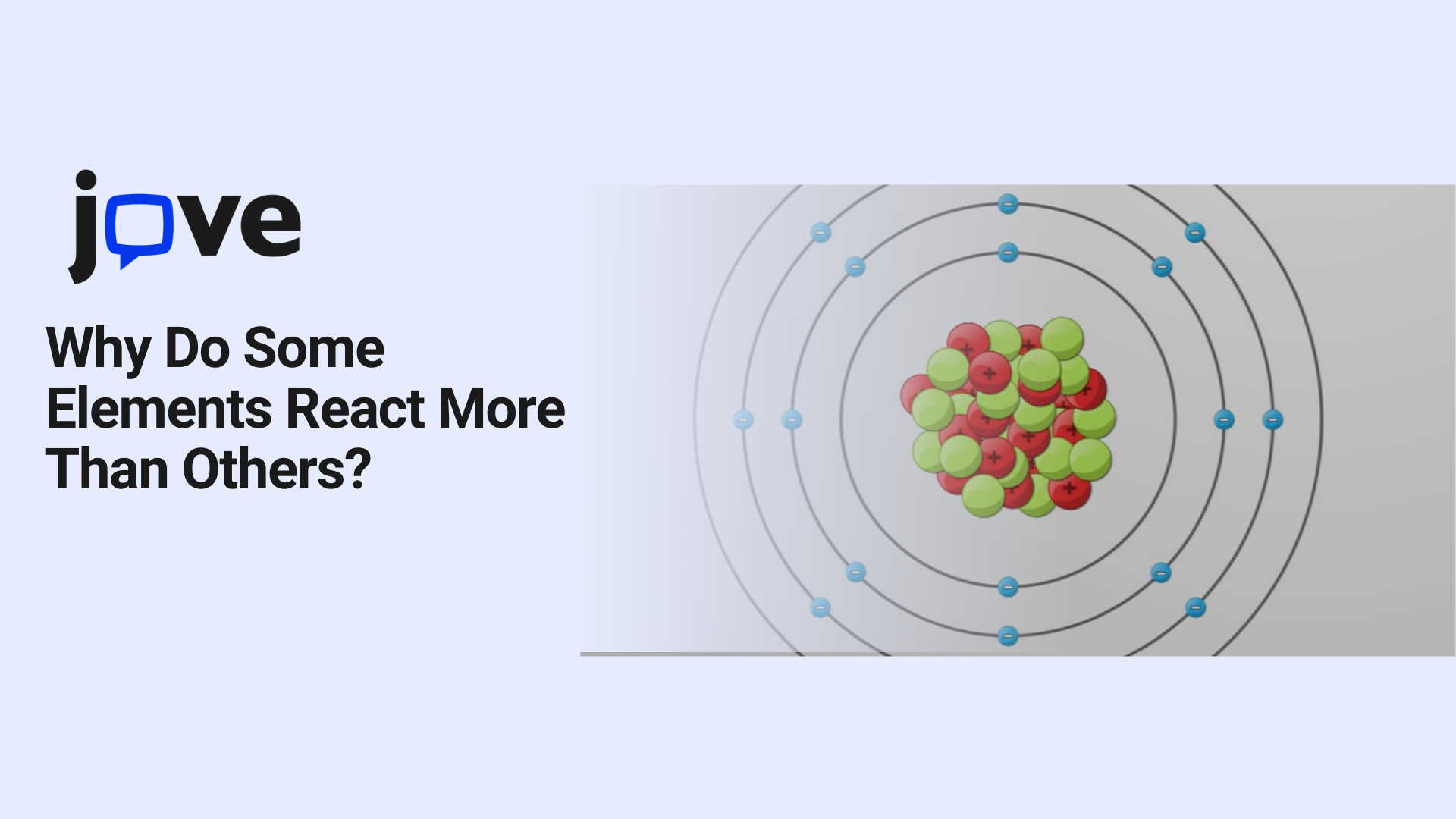
Valence electrons are the electrons located in the outermost energy level (shell) of an atom. They are responsible for:
✅ Determining an element’s chemical reactivity
✅ Forming chemical bonds
✅ Influencing an element’s position in the periodic table
Why Are Valence Electrons So Important?
- Elements with 1–3 valence electrons (like sodium and potassium) tend to lose electrons easily, making them highly reactive metals.
- Elements with 5–7 valence electrons (like oxygen and chlorine) tend to gain electrons, making them highly reactive nonmetals.
- Elements with a full outer shell (like helium or neon) are chemically stable and rarely react.
In JoVE’s Valence Electrons Video, students can watch visual demonstrations of how electron configurations influence reactivity — making complex concepts easier to grasp.
Why Do Some Elements React More Than Others?
The reactivity of an element depends largely on:
1. The Number of Valence Electrons
- Elements with fewer valence electrons (like alkali metals) are highly reactive because they easily lose their outer electrons.
- Elements with nearly full outer shells (like halogens) are also highly reactive because they readily gain electrons to complete their shell.
2. Atomic Size
- Larger atoms have looser outer electrons, making them more reactive. For example, francium is the most reactive metal because its outer electron is easily lost.
3. Shielding Effect
- In larger atoms, inner electron shells reduce the pull of the nucleus on outer electrons, making those outer electrons easier to remove — increasing reactivity.
In JoVE’s periodic trends video, students can visualize these key factors in action through real-world examples.
Common Misconceptions About Valence Electrons
Students often face confusion when learning about valence electrons. Some common misconceptions include:
❌ Believing that all elements in the same group are equally reactive — in reality, reactivity trends increase down certain groups.
❌ Assuming noble gases are completely inert — while rare, some can form compounds under extreme conditions.
❌ Thinking that valence electrons are the same as total electrons — but valence electrons only refer to the outermost shell.
JoVE’s standards aligned visual explanations help address these misconceptions by connecting periodic trends to real-world reactions.
Hands-On Classroom Activity: The Valence Electron Challenge
This activity allows students to predict and test the reactivity of different elements using a simple experiment.
Materials:
- Small samples of sodium, magnesium, and aluminum (handled safely by the instructor)
- Beakers with water
- Phenolphthalein indicator (to observe pH changes)
Steps:
- Prepare the Beakers: Fill three beakers with equal amounts of water and add a few drops of phenolphthalein.
- Test Reactivity: Carefully add small pieces of sodium, magnesium, and aluminum to separate beakers.
- Observe and Record: Ask students to note differences in reaction speed, bubbling, and color change.
- Discuss the Results: Relate the results to each element’s valence electron count and reactivity trend.
In JoVE’s reactivity experiment video, students can visualize these reactions in detail, reinforcing their learning.
Real-World Applications of Valence Electrons
Valence electrons play a crucial role in everyday science and technology:
✅ Batteries: Lithium’s single valence electron makes it ideal for use in rechargeable batteries.
✅ Water Purification: Chlorine’s high reactivity enables it to kill bacteria in drinking water.
✅ Fireworks: Elements like magnesium and strontium burn brightly because of their energetic electron transfers.
In JoVE’s chemistry in action videos, students can explore these real-world connections to deepen their understanding.
Conclusion: Visualizing Chemistry with JoVE Videos
Understanding valence electrons is essential to mastering chemical reactivity. By combining JoVE’s interactive videos with hands-on experiments like the Valence Electron Challenge, educators can help students visualize abstract concepts and improve their understanding.
Next Steps:
- Explore JoVE’s valence electron resources to enhance your lessons
- Try the Valence Electron Challenge to make reactivity trends memorable
- Encourage students to identify chemical reactions in everyday life — from rusting metal to the fizzing of antacid tablets
With engaging visuals and practical experiments, students can unlock the mysteries of why some elements explode while others barely react.
Curious to see how JoVE’s interactive chemistry videos can simplify complex concepts for your students?
Unlock full access to JoVE’s library for free. Book a demo with us today and empower your students with engaging science resources!