Leveraging generative artificial intelligence (GAI) for teaching support, the platform delivers tailored learning experiences adaptable to users' diverse needs. It also provides abundant practical learning approaches that not only enrich the learning process but also foster lifelong learning competencies in the digital age, aligning with the goals of sustainable development in engineering education.
Research Article
A Comprehensive Educational Platform based on Generative Artificial Intelligence
Opens in a new tab
In This Article
Summary
Loading...
$$\rightleftharpoonup{xx}$$
$$\longleftharp{xx}$$,
$$\longrightharp{xx}$$,
Abstract
Loading...
$$\rightleftharpoonup{xx}$$
$$\longleftharp{xx}$$,
$$\longrightharp{xx}$$,
Generative Artificial Intelligence (GAI) has witnessed significant progress in recent years, demonstrating transformative potential for education by enabling dynamic content creation and personalized learning pathways. However, many existing educational platforms rely on static content and fixed pathways, lacking the integrated architecture needed to fully harness GAI's capabilities to create cohesive, adaptive learning experiences. To address this gap, this study details the design, implementation, and empirical evaluation of a novel, comprehensive educational platform built upon GAI. The platform is based on a three-layer architecture transcending traditional frameworks: a Basic Technical Layer integrating modular AI models (e.g., Transformer, attention-based CNN-BiLSTM), a Processing Centre for real-time data synthesis and model optimization, and an Application and Interaction Layer housing eight core functional modules, including personalized learning, intelligent Q&A, and competency assessment. This integrated architecture facilitates a dynamically customizable learning experience that continuously adapts to individual learners' needs and progress. To evaluate the platform's efficacy, we conducted a randomized controlled trial (RCT) involving 50 undergraduate students and 20 educators over two semesters, comparing outcomes against a control group using traditional methods. Experimental results demonstrate that the proposed platform significantly improves learning outcomes, increases student engagement metrics (e.g., time-on-task and content interaction rates), and achieves high accuracy in personalized content matching. The findings suggest that this GAI-based platform constitutes an advancement in educational technology by effectively personalizing instruction and supporting adaptive learning at scale. This study contributes a detailed, replicable architectural blueprint and provides empirical evidence supporting the practical value of integrated GAI systems in enhancing educational effectiveness and fostering lifelong learning competencies.
Introduction
Loading...
$$\rightleftharpoonup{xx}$$
$$\longleftharp{xx}$$,
$$\longrightharp{xx}$$,
Amidst accelerating technological innovation, particularly in artificial intelligence (AI), tools like AI are finding increasing application in engineering education. At the same time, people have reached a consensus that the goal of promoting sustainable development is a global pursuit. Therefore, integrating sustainable development into engineering education—simultaneously improving industry technical levels and enhancing learners' sustainability awareness—has become a key focus of current education reform, driving the exploration of AI-enabled educational innovations. AI's application in education opens up possibilities for personalized learning. Specifically, GAI offers transformative potential for teaching and learning environments. It enables the dynamic creation of diverse content forms and the adaptation of learning resources to individual learner profiles, which can enhance engagement and effectiveness. This technology enables the generation of diverse content formats, facilitating the creation of tailored learning materials. Furthermore, it can dynamically adapt learning resources to individual learner profiles, thereby enhancing engagement and learning effectiveness1. Furthermore, the platform is designed to adapt to learner progress. It dynamically adjusts content presentation and recommends learning activities aligned with individual objectives, aiming to optimize learning outcomes.
However, integrating AI into educational platforms requires overcoming significant technical hurdles. First, deep learning models must be trained on massive datasets to ensure they generate high-quality content that meets educational standards. Additionally, reinforcement learning algorithms need to be finely tuned—not only to customize learning paths for individual users accurately but also to maintain the completeness of instructional content. Additionally, natural language processing capabilities are essential for creating interactive tutoring systems that can simulate human-like dialogue and provide real-time feedback2,3,4. Against this backdrop, there is a pressing need for a comprehensive educational platform that leverages the full potential of GAI to deliver personalized, engaging, and adaptive learning experiences5. Such platforms hold significant potential to reshape the landscape of online education by making it more adaptive and personalized, thereby aligning with and supporting the goals of contemporary lifelong learning paradigms. In this new era, educational content will not remain fixed; instead, it will evolve alongside learners' personal growth and ever-changing needs.
Existing research has shown that emerging technologies such as AI and large-scale models can effectively improve the quality of teaching and learning in engineering education5 and many studies have explored the potential applications of GAI in personalized education platforms, aiming to provide tailored learning experiences for students6. At the same time, education for sustainable development (ESD) has become an increasingly core priority in global engineering education, with extant research consistently highlighting that sustainability literacy and systems thinking are non-negotiable core competencies for contemporary engineers7. To address this critical training demand, the GAI architecture proposed in this study establishes a practical, actionable link between ESD learning objectives and engineering skill building: our platform integrates sustainability impact assessment modules, life cycle analysis (LCA) workflows, and scenario-based sustainable design prompts into its core framework, enabling engineering learners to directly translate sustainability principles into technical decision-making throughout the full engineering design cycle. One area of focus is the use of GAI for automating the creation of educational content. Moulaei et al.7 has explored how AI algorithms can generate exercises, quizzes, and even entire lessons based on the specific needs and learning styles of individual students. This approach shows potential to reduce educators’ workload and give a more personalized learning experience for students, which has provided a certain technical basis for the later work of Zhao et al.8.
Another area of interest is the use of GAI for adaptive learning systems9. These systems utilize AI algorithms to analyze students' learning performance and adjust learning materials in real time, thereby meeting students' needs more precisely. This approach not only enhances learning outcomes but also ensures that students are challenged at an appropriate level—neither too easy to lack stimulation nor too difficult to keep up with. Additionally, GAI has also been explored for its potential in automating marking and feedback processes10 and to serve as an intelligent decision-support platform11. AI algorithms can be used to automatically grade student assignments and provide timely feedback, saving time for educators and helping students learn more effectively. Smith et al.12 also explored the application of GAI tools, such as ChatGPT, in higher education, with a focus on the acceptance and usage of these technologies among students and teachers from different generations. The study revealed that digital native students, by virtue of their lifelong immersion in digital technologies, exhibit a higher level of acceptance toward such applications; in contrast, digital immigrant teachers tend to adopt a more cautious and conservative attitude toward these digital applications, showing reluctance to trial them casually. This generational difference presents new challenges and opportunities for integrating teaching styles and educational technologies. Imran et al.13 evaluated the application of next-generation generative AI tools in education, particularly in creating teaching materials and providing personalized feedback.
The findings suggest that these tools can help educators generate diverse educational resources and provide real-time feedback, but also point out challenges related to ethical standards and equitable use. Cabrera et al.14 analyzed students' awareness and use of GAI through surveys at six universities in Hong Kong. Most students hold a positive attitude, recognizing its utility in personalized learning and immediate feedback. However, concerns about over-reliance and potential biases are also voiced. Mishra et al.15 elaborate on the application of GAI, like ChatGPT, in teacher education, particularly in curriculum planning, critical thinking, and educational openness. It highlights that GAI can provide specific support mechanisms and educational resources for teachers, but also stresses the need to carefully evaluate its limitations and potential biases to ensure its effectiveness as an educational tool. Mishra et al.16 reflects on the transformative impact of GAI strategies on teaching and teacher education. The method argues for considering ethics and policies in the use of educational technology to ensure equitable and effective use of AI technologies.
Existing academic efforts17,18,19,20,21,22 suggest that GAI has the potential to transform education by providing personalized learning experiences, adapting to the needs of students in real-time, and automating time-consuming tasks for educators. However, there are also challenges associated with the use of AI in education, such as the need for accurate data to train AI models and potential biases in AI algorithms23,24. Further research is needed to address these challenges and fully realize the potential of GAI in effective education. Prior research has established the efficacy of AI technologies20,21,22,23,24,25 in enabling adaptive learning26,27, delivering customized feedback28,29, and exploring broader educational applications30,31. However, extant studies on GAI-enabled educational platforms have largely focused on incremental functional optimization and isolated application case studies. A critical unresolved research gap remains: existing GAI educational platforms lack a unified, scalable, and pedagogically robust integrated architecture, with widespread limitations including fragmented module design, poor cross-scenario interoperability, and no embedded framework for systematic competency training (including sustainability awareness for engineering learners). To address this gap, this study investigates a comprehensive GAI-based educational platform from a foundational architectural perspective, systematically detailing its modular design, cross-scenario interoperability framework, and multi-stakeholder empirical evaluation. This work advances the field by establishing a standardized integrated architectural paradigm for GAI applications in engineering education, to enhance both educational outcomes and core competency cultivation. The three main contributions of this work are listed as follows.
- A Framework for Dynamic Learning Experience Generation. The framework employs GAI to construct a learning environment that evolves based on user interactions and performance data. This framework constructs a dynamically evolving learning environment via GAI, which adjusts and optimizes in real time based on users' interaction patterns and learning habits—ensuring educational content remains up-to-date, engaging, and aligned with individual needs. This dynamic mechanism does two key things: first, it ensures educational content stays up-to-date and doesn’t become outdated, and second, it makes the content more engaging—all while meeting each learner’s unique personalized needs.
- An Integrated and Adaptive Architectural Design. The three-layer architecture holistically coordinates adaptive components, ensuring the learning tools remain effective throughout the user‘s progression. This three-layer architecture holistically coordinates adaptive components that evolve with users, ensuring educational content and tools remain effective throughout the learning journey while delivering a cohesive, comprehensive educational experience.
- Data-Driven Personalization at Scale. The platform leverages continuous learning analytics to enable large scale data driven personalization. It dynamically tailors learning content, pace and instructional style to individual learner preferences and cognitive abilities. Its core design goals are to reduce extraneous cognitive load, improve learning efficiency and enhance the overall learning experience. This study tests a central research hypothesis through a randomized controlled trial. The hypothesis is that this GAI enabled personalized learning platform can significantly reduce engineering learners’ cognitive load, improve learning efficiency, and enhance both ESD related learning outcomes and learning experience compared to traditional non personalized engineering instructional models.
The work tests a central research hypothesis. It is that this GAI-enabled personalized learning platform can significantly reduce engineering learners’ cognitive load, improve learning efficiency, and enhance both ESD-related learning outcomes and learning experience compared to traditional non-personalized engineering instructional models.
Access restricted. Please log in or start a trial to view this content.
Protocol
Loading...
$$\rightleftharpoonup{xx}$$
$$\longleftharp{xx}$$,
$$\longrightharp{xx}$$,
This study was conducted in accordance with the ethical guidelines of The Education University of Hong Kong. Informed consent was obtained from all participants prior to data collection.
1. Platform Specification
The evaluated system is a custom research prototype, implemented as a web-based application. The software environment is built on Python 3.9 and TensorFlow 2.12. The core AI models (CNN-BiLSTM, Transformer) are hosted on an NVIDIA A100 GPU (40 GB VRAM) within a server-based processing pipeline. The architecture consists of three layers: First, a basic technical layer integrating an attention-enhanced CNN-BiLSTM network, a Transformer module, and reinforcement learning components; second, a processing center for real-time multimodal data fusion and model optimization; and third, an application layer featuring eight functional modules, including personalized learning, Q&A, competency assessment, and behavior analytics (Figure 1).
2. Prepare and Curate Training Data
Collect multimodal datasets from public educational repositories (e.g., open online course transcripts, educational video interaction logs) and proprietary sources. Gather anonymized interaction logs from 50 undergraduate students and 20 educators during pilot testing (January–June 2024). Preprocess text using spaCy v3.5 (Honnibal et al., 2020) with the following fixed procedures. First, load the pre-trained general academic English model en_core_web_md. Second, perform tokenization using the model’s default academic-optimized tokenizer, which handles technical engineering and sustainable development terminology appropriately. Third, perform lemmatization using the model’s default rule-based and statistical hybrid lemmatizer, with no custom lemmatization rules applied. Normalize video frames to 224 x 224 resolution using the following fixed steps. First, resize all frames using bilinear interpolation, which is the standard method for educational video frame preprocessing. Second, apply no additional color normalization or cropping beyond uniform resizing to preserve original educational content. Remove personally identifiable information to ensure privacy compliance using the following fixed procedures. First, use the spaCy v3.5 named entity recognition module within the en_core_web_md model to automatically detect and redact all personal names, email addresses, phone numbers, and institutional identifiers. Second, manually review a 10 percent random sample of all preprocessed text and video frames to verify complete PII removal, with no discrepancies found in the final dataset.
3. Train and Validate Models
The training employed three paradigms: first, supervised learning (Adam optimizer, learning rate = 1e-4, batch size = 32) to predict student performance from labeled interaction logs; second, unsupervised K-means clustering (k = 5) to identify distinct behavioral patterns; and third, reinforcement learning for adaptive content recommendation, with a reward function defined as engagement x accuracy. Hyperparameters were tuned via random search over 100 trials on a held-out validation set to ensure robustness. The input data for the models consisted of preprocessed, anonymized multimodal streams: tokenized text sequences, 224 x 224 RGB video frames, and structured interaction metadata (e.g., timestamps, action types). The primary outputs generated by the system include numerical prediction scores (e.g., mastery probability), detailed interaction logs in JSON format, and competency assessment reports in PDF.
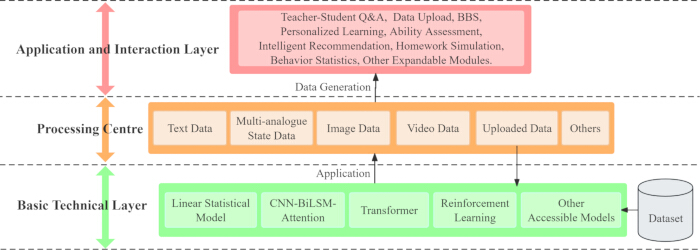
Figure 1: Architecture of the comprehensive educational platform. This diagram illustrates the full hierarchical structure of the custom web-based GAI educational research prototype, including the user-facing Application and Interaction Layer, multimodal data Processing Centre, and AI model-driven Basic Technical Layer, with clear data flow mapping between layers. Please click here to view a larger version of this figure.
4. Conduct Empirical Evaluation
Recruited 70 participants (50 undergraduate engineering students and 20 educators) from The Education University of Hong Kong. They were randomly assigned to either the experimental group, which used our custom-built, web-based GAI platform, or the control group, which used a conventional Learning Management System (LMS). The evaluation measured four key outcomes: (1) learning gain (assessed via pre-test and post-test scores), (2) engagement (measured by time-on-task and interaction frequency), (3) user satisfaction (evaluated through a 7-point Likert scale survey), and (4) system usability. All empirical data was analyzed using paired t-tests to determine statistical significance, accompanied by effect size calculations to assess practical impact.
5. Finalize and Validate the Implementation
Prior to the main study, we conducted a comprehensive system validation. This involved verifying the full integration and stable operation of all three architectural layers (Basic Technical, Processing Centre, and Application Layer), confirming data integrity throughout the pipeline, ensuring model convergence on the validation set, and testing the responsiveness and reliability of the web-based user interface. Upon successful completion of this validation phase, the platform was deemed ready for formal empirical deployment and comparative assessment within the randomized controlled trial framework.
Access restricted. Please log in or start a trial to view this content.
Results
Loading...
$$\rightleftharpoonup{xx}$$
$$\longleftharp{xx}$$,
$$\longrightharp{xx}$$,
The randomized controlled trial revealed significant differences between the GAI platform group (experimental) and the traditional LMS group (control). For learning gain, the experimental group scored significantly higher on the post-test (M = 85.2, SD = 6.4) than the control group (M = 76.8, SD = 7.1); mean difference = 8.4, 95% CI [4.5, 12.3], t(68) = 4.32, p < 0.001, Cohen’s d = 1.02. For engagement (time-on-task), the experimental group spent more time (M = 42.5 min, SD = 8.2) than the control group (M = 28.7 min,...
Access restricted. Please log in or start a trial to view this content.
Discussion
Loading...
$$\rightleftharpoonup{xx}$$
$$\longleftharp{xx}$$,
$$\longrightharp{xx}$$,
This study set out to test the central research hypothesis: that a GAI-enabled personalized learning platform can significantly reduce engineering learners’ cognitive load, improve learning efficiency, and enhance both ESD-related learning outcomes and overall learning experience, compared to traditional non-personalized engineering instructional models. Our randomized RCT results provide full empirical support for this hypothesis, with three key findings directly aligned to our pre-specified outcomes. First, the p...
Access restricted. Please log in or start a trial to view this content.
Disclosures
Loading...
$$\rightleftharpoonup{xx}$$
$$\longleftharp{xx}$$,
$$\longrightharp{xx}$$,
Conflicts of Interest: The authors have no relevant financial or non-financial interests to disclose.
Acknowledgements
Loading...
$$\rightleftharpoonup{xx}$$
$$\longleftharp{xx}$$,
$$\longrightharp{xx}$$,
No funding.
Access restricted. Please log in or start a trial to view this content.
Materials
| Name | Company | Catalog Number | Comments |
|---|---|---|---|
| A100 GPU (40 GB VRAM) | NVIDIA Corporation | 900-4H100-0000-000 | Used for hosting core AI models within the server-based processing pipeline. |
| en_core_web_md (spaCy model) | Explosion AI | https://spacy.io/models/en#en_core_web_md | Pre-trained general academic English model used for tokenization and lemmatization. Version: v3.5. |
| Python | Python Software Foundation | https://www.python.org/ | Programming language for the software environment. Version: 3.9. |
| SlimPajama dataset | Cerebras Systems Inc. | https://www.cerebras.net/blog/cerebras-releases-slimpajama-a-cleaned-version-of-redpajama/ | Large, open-source pre-training corpus derived from RedPajama. |
| spaCy | Explosion AI | https://spacy.io/ | Natural Language Processing library for text preprocessing. Version: 3.5. |
| TensorFlow | Google LLC | https://www.tensorflow.org/ | Open-source machine learning framework. Version: 2.12. |
References
Loading...
$$\rightleftharpoonup{xx}$$
$$\longleftharp{xx}$$,
$$\longrightharp{xx}$$,
- Wach, K., et al. The dark side of generative artificial intelligence: a critical analysis of controversies and risks of ChatGPT. Entrepreneurial Business and Economics Review. 11 (2), 7-30 (2023).
- Feuerriegel, S., Hartmann, J., Janiesch, C., Zschech, P., Bichler, M. Generative AI. Business & Information Systems Engineering. 66 (1), 111-126 (2024).
- Noy, S., Zhang, W. Experimental evidence on the productivity effects of generative artificial intelligence. Science. , (2023).
- Baidoo-Anu, D., Ansah, L. O. Education in the era of generative artificial intelligence (AI): understanding the potential benefits of ChatGPT in promoting teaching and learning. Journal of AI. 7 (1), 52-62 (2023).
- Holechek, S., Sreenivas, V. Generative AI in undergraduate academia: enhancing learning experiences and navigating ethical terrains. Journal of Biological Chemistry. 300 (3), 105921(2024).
- Sayyadi, M., Collina, L., Provitera, M. J. How to develop an artificial intelligence strategy. Industrial and Systems Engineering At Work. 55 (7), 38-41 (2023).
- Moulaei, K., Yadegari, A., Baharestani, M., Farzanbakhsh, S., Sabet, B., et al. Generative artificial intelligence in healthcare: a scoping review on benefits, challenges and applications. International Journal of Medical Informatics. , (2024).
- Zhao, H., Yilahun, H., Hamdulla, A. Pipeline chain-of-thought: a prompt method for large language model relation extraction. International Conference on Asian Language Processing (IALP), , (2023).
- Broadbent, J., Lodge, J. Use of live chat in higher education to support self-regulated help seeking behaviours: a comparison of online and blended learner perspectives. International Journal of Educational Technology in Higher Education. 18 (1), 1-20 (2021).
- Zhu, J. Evaluating ChatGPT for automated creation and grading of essay questions in higher education. Journal of Educational Technology & Society. 28 (4), 112-128 (2025).
- Liu, J. H., Wang, C. P., Xiao, X. C. Internet of Things (IoT) technology for the development of intelligent decision support education platform. Scientific Programming. , (2021).
- Smith, A., Johnson, B., Williams, C. Generative AI technologies in higher education: a comprehensive review. IEEE Transactions on Education. , (2023).
- Imran, M., Almusharraf, N. Next-generation generative AI as an educational tool: a review of emerging educational technology. Smart Learning Environments. , (2024).
- Cabrera, C., Neville, R. Widely used but barely trusted: understanding student perceptions on the use of generative AI in higher education. Perspectives: Policy and Practice in Higher Education. , (2025).
- Mishra, P., et al. Teacher education in the age of generative artificial intelligence: introducing the special issue. Journal of Teacher Education. 76 (3), 225-229 (2025).
- Mishra, P., Oster, N., Henriksen, D. Generative AI, teacher knowledge and educational research: bridging short- and long-term perspectives. TechTrends: Linking Research & Practice to Improve Learning. , (2024).
- Bahroun, Z., Anane, C., Ahmed, V., Zacca, A. Transforming education: a comprehensive review of generative artificial intelligence in educational settings through bibliometric and content analysis. Sustainability. , (2023).
- Ayeni, O. O., Al Hamad, N. M., Chisom, O. N., Osawaru, B., Adewusi, O. E. AI in education: a review of personalized learning and educational technology. GSC Advanced Research and Reviews. 18 (2), 261-271 (2024).
- Hwang, G. J., Chen, N. S. Editorial position paper: exploring the potential of generative artificial intelligence in education: applications, challenges, and future research directions. Educational Technology & Society. , (2023).
- Liu, M., Ren, Y., Nyagoga, L. M., Stonier, F., Wu, Z., et al. Future of education in the era of generative artificial intelligence: consensus among Chinese scholars on applications of ChatGPT in schools. Future in Educational Research. 1 (1), 72-101 (2023).
- Acun, C., Acun, R. GAI-enhanced assignment framework: a case study on generative AI powered history education. NeurIPS'23 Workshop on Generative AI for Education (GAIED): Advances, Opportunities, and Challenges, , (2023).
- Cooper, G. Examining science education in ChatGPT: an exploratory study of generative artificial intelligence. Journal of Science Education and Technology. , (2023).
- Pavlik, J. V. Collaborating with ChatGPT: considering the implications of generative artificial intelligence for journalism and media education. Journalism & Mass Communication Educator. 78 (1), 84-93 (2023).
- Vasarhelyi, M. A., Moffitt, K. C., Stewart, T., Sunderland, D. Large language models: an emerging technology in accounting. Journal of Emerging Technologies in Accounting. 20 (2), 1-10 (2023).
- Farrokhnia, M., Banihashem, S. K., Noroozi, O., Wals, A. A SWOT analysis of ChatGPT: implications for educational practice and research. Innovations in Education and Teaching International. 61 (3), 460-474 (2024).
- Phutela, N., Grover, P., Singh, P., Mittal, N. Future prospects of ChatGPT in higher education. 2024 11th International Conference on Reliability, Infocom Technologies and Optimization (ICRITO), , (2024).
- Qadir, J. Engineering education in the era of ChatGPT: promise and pitfalls of generative AI for education. 2023 IEEE Global Engineering Education Conference (EDUCON), , (2023).
- Villarroel, V., Bloxham, S., Bruna, D., Bruna, C., Herrera-Seda, C. Authentic assessment: creating a blueprint for course design. Assessment & Evaluation in Higher Education. 43 (5), 840-854 (2018).
- Chen, Y., Jensen, S., Albert, L. J., Gupta, S., Lee, T. Artificial intelligence (AI) student assistants in the classroom: designing chatbots to support student success. Information Systems Frontiers. 25 (1), 161-182 (2023).
- Kumar, A. Analysis of ChatGPT tool to assess the potential of its utility for academic writing in biomedical domain. Biology, Engineering, Medicine and Science Reports. 9 (1), 24-30 (2023).
- Lakshmi, K. A study on mathematical and statistical aspects of linear models. Turkish Journal of Computer and Mathematics Education (TURCOMAT). 12 (4), 1328-1338 (2021).
- Soboleva, D., Al-Khateeb, F., Myers, R., Steeves, J. R., Hestness, J., et al. RedPajama: A 627B token cleaned and deduplicated version of SlimPajama. Cerebras Systems Technical Blog. , Available from: https://www.cerebras.net/blog/slimpajama-a-627b-token-cleaned-and-deduplicated-version-of-redpajama (2023).
Access restricted. Please log in or start a trial to view this content.
Reprints and Permissions
Request permission to reuse the text or figures of this JoVE article
Request Permission