This protocol describes a standardized, multicomponent respiratory guidance and nursing intervention incorporating breathing training, exercise, and supportive care to improve pulmonary function and functional outcomes in elderly patients with chronic obstructive pulmonary disease.
Method Article
A Standardized Multicomponent Respiratory Guidance and Nursing Care Protocol for Elderly Patients with Chronic Obstructive Pulmonary Disease
* These authors contributed equally
Opens in a new tab
In This Article
Summary
Loading...
$$\rightleftharpoonup{xx}$$
$$\longleftharp{xx}$$,
$$\longrightharp{xx}$$,
Abstract
Loading...
$$\rightleftharpoonup{xx}$$
$$\longleftharp{xx}$$,
$$\longrightharp{xx}$$,
This protocol describes a standardized, reproducible, multicomponent respiratory guidance and nursing care intervention for elderly patients with chronic obstructive pulmonary disease (COPD). Based on Orem’s self-care deficit nursing theory, the method integrates structured breathing training, respiratory muscle training, aerobic exercise, and continuous nursing support. The intervention is delivered by trained respiratory nurses over a 12-week period in inpatient and outpatient settings. The protocol includes procedures for patient selection, group allocation, baseline assessment, and structured implementation of intervention components. Breathing training incorporates guided respiratory exercises and spirometer-assisted techniques, combined with individualized exercise programs, psychological support, and discharge planning. The protocol specifies intervention frequency, duration, supervision, safety monitoring, and adherence tracking to ensure consistency and reproducibility. Standardized outcome assessment procedures are outlined, including pulmonary function testing, arterial blood gas analysis, dyspnea evaluation, functional ability assessment, sleep quality measurement, and quality-of-life evaluation using validated clinical instruments. This protocol provides a practical and structured framework for implementing nonpharmacological respiratory care in elderly patients with COPD across clinical and rehabilitation settings.
Introduction
Loading...
$$\rightleftharpoonup{xx}$$
$$\longleftharp{xx}$$,
$$\longrightharp{xx}$$,
Chronic obstructive pulmonary disease (COPD) is a common respiratory disorder in older adults1. It encompasses chronic bronchitis and emphysema and is typically characterized by airflow limitation, shortness of breath, chronic dyspnea, cough, fatigue, chest tightness, weight loss, wheezing, and, in severe cases, respiratory failure2. Major risk factors include tobacco smoking, exposure to indoor air pollution, and occupational pollutants3. The disease substantially impairs quality of life and is associated with high morbidity and mortality4. Diagnosis is based on characteristic clinical manifestations together with spirometric evidence of airflow obstruction5. Yet, timely and accurate diagnosis is often difficult in elderly patients because the symptoms are non-specific, frequently overlap with common comorbidities, and may be further complicated by variable spirometry performance in older adults6. COPD is also highly prevalent in aging populations. A study from the United States reported that from 2014 to 2015, the overall prevalence was 6% among adults and reached 10% and 15% among former and current cigarette smokers, respectively7. Its incidence continues to rise, particularly with changes in lifestyle, population aging, and urbanization.
These realities highlight the need for appropriate diagnostic and management strategies, especially for older adults with a current or previous smoking history. The goal is to ensure that both pharmacologic and nonpharmacologic measures are used appropriately to control symptoms and improve overall well-being8,9. Although drug therapy can relieve symptoms, slow disease progression, and reduce hospital readmission10, it cannot reverse the progressive decline in pulmonary function. In elderly patients, polypharmacy may also increase the risk of adverse drug reactions and poor medication adherence. Routine clinical nursing, meanwhile, is often centered on symptom management and medication instruction, with limited systematic, individualized respiratory guidance and sustained nursing support; as a result, it may do little to improve functional independence or long-term quality of life. In addition to the usual care, we designed personalized care for respiratory function. Compared with routine care and drug treatment alone, the present protocol offers several practical advantages: it is noninvasive, free from drug-related adverse effects, easy to implement, and applicable throughout the full course from hospitalization to post-discharge care. By combining multicomponent respiratory guidance with nursing support, it is intended to improve respiratory muscle function and self-care capacity in elderly patients and, in doing so, address gaps in current nursing practice. This protocol is suitable for stable elderly patients aged ≥65 years who have been diagnosed with COPD according to the Global Initiative for Chronic Obstructive Lung Disease (GOLD) criteria and are classified as grade II–III on pulmonary function testing. It can be delivered by respiratory specialist nurses who have received standardized training in respiratory wards of secondary or higher-level hospitals, respiratory rehabilitation clinics, and community health service centers. It is not appropriate for patients with COPD complicated by severe cardiac, hepatic, or renal disease, cognitive impairment, malignant tumors, or active tuberculosis. Effective nursing care, therefore, remains an important adjunct to pharmacologic treatment for improving the condition and well-being of patients with COPD.
Respiratory guidance and nursing care for patients with COPD are intended to improve respiratory function, promote recovery, and enhance overall well-being. In practice, pulmonologists, respiratory nurses, and respiratory physiotherapists can work together to develop individualized, evidence-based care plans that target symptoms and functional impairment11. Within this framework, care pathways and specialized respiratory services can be integrated to deliver more coordinated, efficient care. Such plans can include patient education, smoking cessation support, emotional support, and pulmonary rehabilitation (PR)12. PR comprises non-pharmacological measures that help relieve COPD symptoms by improving oxygen utilization, strengthening muscles, and reducing episodes of breathlessness. Rochester et al. reported that patients with mild to moderate COPD benefit from PR12. Exercise training and behavioral modification, including smoking cessation, have also been associated with reduced anxiety and depression and with improved cognition13. As a therapeutic approach tailored to individual needs, PR aims to reduce symptoms such as dyspnea and shortness of breath while improving quality of life, including by alleviating fatigue and enhancing emotional functioning14. Moreover, participation in PR is linked to better functional status and a lower risk of hospital readmission in patients with COPD15. Even so, relatively few studies have focused specifically on respiratory guidance and nursing care for elderly patients to improve quality of life through symptom relief. According to Orem’s Self-Care Deficit Nursing Theory, COPD-related functional decline leads to self-care deficits requiring structured nursing interventions.
The goal of this method is to provide a standardized, reproducible respiratory guidance and nursing care protocol to improve pulmonary function and functional outcomes in elderly patients with COPD. The protocol is designed to address self-care deficits, thereby improving functional independence and respiratory outcomes. Against this background, the present article provides a detailed description of a standardized, feasible, and reproducible respiratory guidance and nursing care protocol for elderly patients with COPD. It clarifies the implementation process, operating procedures, quality control measures, and outcome assessment methods, aiming to provide a standardized, generalizable reference for nonpharmacological nursing interventions in respiratory inpatient and outpatient settings.
Access restricted. Please log in or start a trial to view this content.
Protocol
Loading...
$$\rightleftharpoonup{xx}$$
$$\longleftharp{xx}$$,
$$\longrightharp{xx}$$,
Approval for this study was obtained from the Ethics Committee at Ningbo University. Obtain written informed consent from all participants or from their legal representatives, including close family members or caregivers where applicable.
1. Participant enrollment and ethical compliance
- Submit the study protocol, intervention content, and potential risks to the institutional ethics committee of the implementing hospital.
- Obtain ethical approval from the institutional ethics committee.
- Provide full details of the protocol, intervention content, and potential risks to eligible patients and their legal guardians.
- Obtain written informed consent from all participants or their legal guardians before enrollment.
- Ensure that outcome assessors and statistical analysts remain unaware of the study-group assignments.
2. Protocol preparation and design
- Develop the respiratory guidance and nursing care protocol using the 2024 GOLD guidelines for COPD management as the core reference16.
- Consider the clinical characteristics of elderly patients with COPD and the needs of clinical nursing practice during protocol development.
- Formulate the protocol through multidisciplinary consultation among respiratory physicians, respiratory specialist nurses, nursing managers, and rehabilitation therapists.
- Refer to Figure 1 for the main flow of the study.
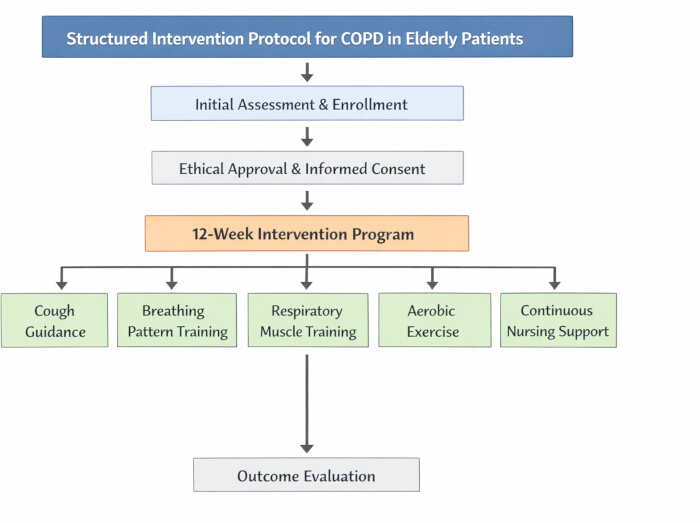
Figure 1. Workflow of the structured intervention protocol for elderly patients with COPD. The flowchart illustrates the study design, including initial assessment and enrollment, ethical approval and informed consent, and the 12-week intervention program. The intervention consists of cough guidance, breathing pattern training, respiratory muscle training, aerobic exercise, and continuous nursing support. Outcome evaluation was conducted at the end of the intervention period. Please click here to view a larger version of this figure.
3. Participant recruitment and group allocation
- Conduct the study using a nonrandomized, time-sequenced controlled design.
- Enroll 135 elderly patients with COPD admitted between January and December 2022.
- Use a time-sequenced group allocation strategy to eliminate intervention contamination between the control and intervention groups in the same inpatient ward setting. Enroll patients in two non-overlapping time periods so that only one care model is implemented in the ward at any given time. Introduce intervention materials and nurse-led training only during the intervention phase to prevent cross-intervention exposure.
NOTE: This strategy minimizes temporal confounding by using a fixed study team, fully standardized care protocols, equal seasonal coverage of enrollment windows, and strict baseline matching to ensure consistency across the two study periods. - Assign patients admitted from January to June 2022 to the control (con.) group and provide routine care.
- Assign patients admitted from July to December 2022 to the research (res.) group and provide the respiratory guidance and nursing care intervention. Ensure baseline comparability with the con. group for baseline characteristics, including age, sex, smoking history, and GOLD pulmonary function grade.
- Compare baseline characteristics between groups using appropriate statistical tests (e.g., independent-samples t test and chi-square test) to confirm no statistically significant differences.
- Include 69 patients in the res. group, comprising 45 men and 24 women.
- Include 66 patients in the con. group, comprising 43 men and 23 women.
- Monitor and record any serious adverse reactions (abnormal reactions that may be life-threatening, cause permanent damage, or require urgent medical intervention, such as anaphylactic shock, liver failure, or seizures) during the intervention period.
4. Participant screening criteria
- Apply inclusion criteria
- Confirm that the patient has been diagnosed with COPD according to the GOLD criteria.
- Confirm that pulmonary function is classified as grade II (FEV1 was 50%–79% predicted; shortness of breath after exercise and limitation of daily activities) or III (FEV1 ranged from 30% to 49% predicted; dyspnea may also occur at rest, with frequent acute exacerbations).
- Confirm that the patient is aged ≥65 years.
- Confirm that complete clinical data are available.
- Apply exclusion criteria
- Exclude patients aged <65 years.
- Exclude patients with severe hypertension (systolic blood pressure ≥180 mmHg and/or diastolic blood pressure ≥120 mmHg) or cardiovascular disease.
- Exclude patients with acute hepatic or renal dysfunction.
- Exclude patients with language impairment, cognitive impairment, hearing disability, or mental illness.
- Exclude patients with malignant tumors or active tuberculosis.
- Exclude patients with poor medication adherence, as determined by clinician assessment based on medical records and patient interview, or those unable to cooperate with treatment.
- Confirm eligibility
- Include only patients who meet all inclusion criteria and none of the exclusion criteria.
- Document eligibility status prior to enrollment.
5. Respiratory guidance and nursing intervention
- General intervention framework
- Base the respiratory guidance and nursing care intervention on Orem’s Self-Care Deficit Nursing Theory. Refer to Figure 2 for a schematic of the protocol. Refer to Table 1 and Table 2 for detailed care protocols, including standardized intervention procedures, implementation frequency, session duration, supervision methods, follow-up management, and quality control measures.
- Apply wholly compensatory, partly compensatory, and supportive-educative nursing systems according to patient condition, based on clinical assessment of functional status and self-care ability.
- Include respiratory skills training, health education, behavioral guidance, and functional support as core components of the intervention. Deliver respiratory training using structured techniques such as diaphragmatic breathing, pursed-lip breathing, effective cough training, and aerobic exercise under nurse supervision, with defined session frequency, duration, and progression. Detailed standardized operating procedures, including stepwise actions and supervision methods, are provided in Table 2.
- Provide standardized pharmacological treatment during hospitalization. Administer tiotropium (18 μg inhaled once daily) if blood eosinophils are <300 and there is no history of frequent acute exacerbations. If dyspnea persists at mMRC grade ≥2 despite initial therapy, escalate treatment to umeclidinium/vilanterol (once daily).
- Encourage patients to expectorate actively to relieve airway obstruction.
- Conduct the intervention and follow-up over a total period of 12 weeks. Deliver intervention sessions according to predefined daily frequency, session duration, and progressive intensity adjustments, including dose escalation for aerobic training, as detailed in Table 2.
- Implement routine nursing care for the control group and respiratory guidance and nursing care for the intervention group according to the standardized protocols provided in Table 1 and Table 2.
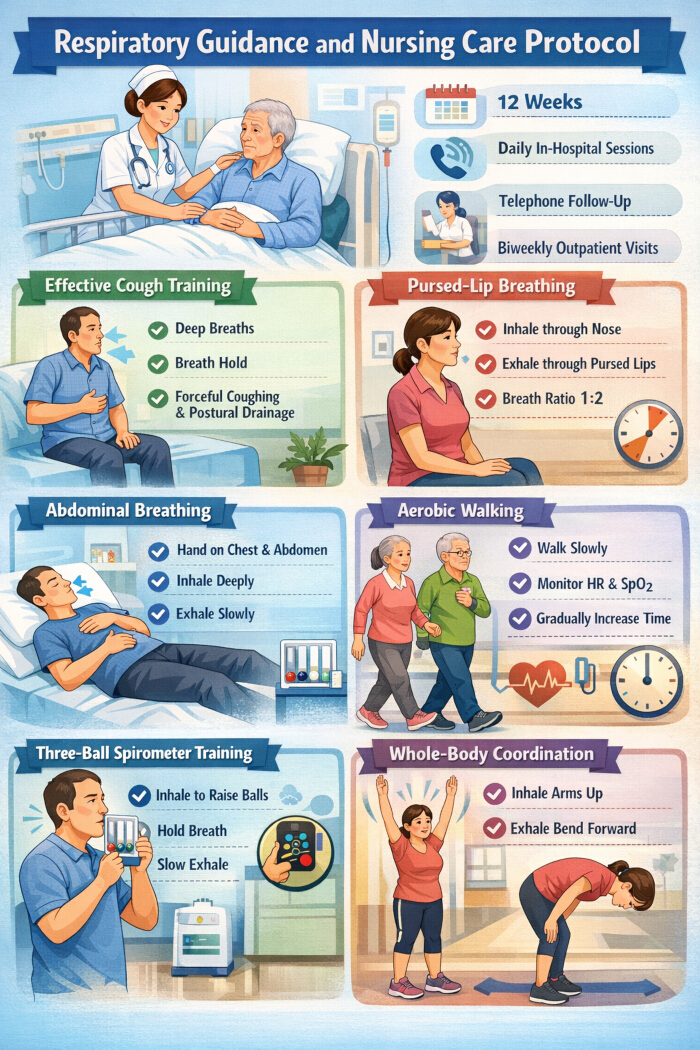
Figure 2. Components of the respiratory guidance and nursing care protocol. The schematic illustrates the structured 12-week intervention program, including daily in-hospital sessions, telephone follow-up, and biweekly outpatient visits. The intervention components include effective cough training, pursed-lip breathing, diaphragmatic (abdominal) breathing, aerobic walking exercise, spirometer-based respiratory muscle training, and whole-body coordination exercises. Each component is designed to improve respiratory function, physical endurance, and self-care ability in elderly patients with COPD. Please click here to view a larger version of this figure.
Table 1: Control group (con. group) complete protocol details. The total period of care and observation was 12 weeks (from admission to the end of the study). Please click here to download this Table.
Table 2: Details of the complete care protocol for the res. group (standardized multicomponent breathing-guided care group). The total period of intervention and care was 12 weeks (from admission to study endpoint). On the basis of the routine nursing process (including basic drug treatment, symptomatic support, baseline/endpoint assessment), the following standardized respiratory guidance and specialized nursing interventions were implemented in the res. group. The holistic intervention was based on Orem self-care deficit nursing theory, and according to the patient's condition, full compensation, partial compensation and supportive-educative nursing systems were adopted. Please click here to download this Table.
6. Implementation standardization and quality control
- Standardized nurse training
- Deliver a 1-week (20 class hours) standardized training covering COPD guidelines, intervention SOPs, scale use, and adverse event management, using unified training materials.
- Ensure that the pass criteria include a theoretical score ≥80/100 and a practical operation score ≥85/100.
- Allow only qualified nurses to deliver the intervention.
- Adherence management
- Calculate the monthly adherence rate as (actual completed valid training sessions / total planned sessions) × 100%, where a valid training session is defined as completion of at least 80% of the planned session content.
- Define adherence ≥80% as good adherence.
NOTE: Provide targeted guidance and family supervision for patients with poor adherence to improve compliance.
- Standardized monitoring
- Use uniformly calibrated finger pulse oximeters.
- Record heart rate and oxygen saturation at 5 min before training, every 5 min during training, and 5 min post-training.
- Perform real-time symptom documentation and daily verification of recorded vital signs and symptom data by a second trained nurse.
CAUTION: Stop training immediately if HR >120 beats/min, SpO2 <90%, or if severe discomfort occurs. Provide bed rest, oxygen support, and physician notification as needed.
7. Outcome assessment
- Measure forced vital capacity (FVC), forced expiratory volume in 1 s (FEV1), and FEV1/FVC using a pulmonary function testing system. Perform spirometry with the patient in a seated position, obtain at least three acceptable maneuvers, and record the best value.
- Perform baseline measurements within 48 h of admission and post-intervention measurements within 72 h after completion of the 12-week intervention.
- Measure arterial partial pressure of carbon dioxide (PCO2), arterial partial pressure of oxygen (PaO2), and arterial oxygen saturation (SaO2) using a fully automated blood gas analyzer. Collect arterial blood samples from the radial artery with the patient at rest and without supplemental oxygen for at least 20 min prior to sampling. Perform puncture after disinfection, apply pressure after needle withdrawal to stop bleeding, and immediately mix and send the sample for analysis.
- Assess daily living capacity using the Activities of Daily Living (ADL) scale (0–100). Include items such as grooming, toileting, eating, and bathing activities.
NOTE: Interpret ADL scores as follows: <20 = total dependence; 20–40 = severe impairment; 40–60 = moderate assistance; ≥60 = basic self-care ability. - Assess quality of life, including general health, mental health, physical functioning, social functioning, pain, and vitality, using the Medical Outcomes Study 36-Item Short-Form Health Survey (MOS SF-36).
- Evaluate dyspnea using the Modified British Medical Research Council (mMRC) scale.
NOTE: Classify dyspnea as follows: Grade 0 = dyspnea only after strenuous exercise; Grade 1 = dyspnea when walking quickly or uphill; Grade 2 = slower walking than peers or the need to stop for rest; Grade 3 = stopping after approximately 100 m or after a few minutes of walking; and Grade 4 = too breathless to leave home or to dress. - Interpret higher scores as more severe dyspnea.
- Assess sleep quality using the Chinese version of the Pittsburgh Sleep Quality Index (PSQI).
- Include 7 components comprising 19 items.
NOTE: Interpret PSQI scores as follows: 0–5 = good sleep; 6–10 = fair sleep; 11–15 = moderate disturbance; 16–21 = poor sleep quality.
8. Statistical analysis
- Use statistical analysis software (see Table of Materials). Confirm that no data are missing.
- Import data from the res. group and con. group into the software.
- Express enumeration data as percentages (%).
- Assess data distribution using the Shapiro–Wilk test.
- Express normally distributed data as mean ± standard deviation.
- Compare groups using the independent-samples t test.
- Perform a paired t test for intragroup comparison.
- Express non-normally distributed data as median and interquartile range [M(P25, P75)].
- Compare groups using the Mann–Whitney U test.
- Define statistical significance as p < 0.05.
Access restricted. Please log in or start a trial to view this content.
Results
Loading...
$$\rightleftharpoonup{xx}$$
$$\longleftharp{xx}$$,
$$\longrightharp{xx}$$,
Demographic characteristics
The study sample consisted of 135 elderly patients with COPD (Figure 3). They were divided into two groups according to the intervention received: a res. group (51.1% of cases) that received the respiratory guidance and nursing care protocol, and a con. group (48.9% of cases) that received routine care (Table 3). In the res. group, there were 45 men and 24 women, whereas in the con. group, there were 43 men and 23 w...
Access restricted. Please log in or start a trial to view this content.
Discussion
Loading...
$$\rightleftharpoonup{xx}$$
$$\longleftharp{xx}$$,
$$\longrightharp{xx}$$,
As a progressive respiratory disorder, COPD poses a substantial challenge to the health of elderly patients and remains a major focus and difficulty in clinical respiratory nursing practice1. In this study, a standardized respiratory guidance and nursing care protocol was developed and implemented for elderly patients with COPD. We evaluated its effects on pulmonary function, ADL, dyspnea, sleep quality, and overall quality of life, while also establishing a set of structured and reproducible oper...
Access restricted. Please log in or start a trial to view this content.
Disclosures
Loading...
$$\rightleftharpoonup{xx}$$
$$\longleftharp{xx}$$,
$$\longrightharp{xx}$$,
All authors declare no conflicts of interest related to the content of this article.
Acknowledgements
Loading...
$$\rightleftharpoonup{xx}$$
$$\longleftharp{xx}$$,
$$\longrightharp{xx}$$,
This work was supported by the Ningbo Public Welfare Project, “The Construction and Application of an Intelligent Chronic Disease Management System with Hospital-Community-Family Integration from the Perspective of Whole-Cycle Health” (No. 2023S039) and the Ningbo Public Welfare Project, “The Construction of a Multimodal Risk Model for Elderly Muscle Atrophy and Expansion of Practical Techniques for Intervention Research” (No. 2023S051).
Access restricted. Please log in or start a trial to view this content.
Materials
| Name | Company | Catalog Number | Comments |
|---|---|---|---|
| Activities of Daily Living (ADL) scale (https://www.wjx.cn/xz/247223917.aspx) | Changsha Ranxing Information Technology Co., Ltd. | N/A | Used to assess daily living capacity |
| Fully automated blood gas analyzer | Radiometer Medical ApS (Denmark) | ABL800 FLEX | Used for rapid measurement of arterial blood gas parameters, including pH, PaO2, PaCO2, and electrolytes |
| Modified British Medical Research Council (mMRC) dyspnea scale (https://www.wjx.cn/xz/228071123.aspx) | Changsha Ranxing Information Technology Co., Ltd. | N/A | Used to assess dyspnea severity |
| Pittsburgh Sleep Quality Index (PSQI) (https://www.wjx.cn/xz/343882592.aspx) | Changsha Ranxing Information Technology Co., Ltd. | N/A | Used to assess sleep quality |
| Pulse oximeter | Mindray Bio-Medical Electronics Co., Ltd. (China) | PM-60 | Used to monitor oxygen saturation during training |
| Pulmonary function testing system (spirometer) | Mindray Bio-Medical Electronics Co., Ltd. (China) | MSA99 | Used to measure FVC, FEV1, and FEV1/FVC |
| SPSS statistical analysis software | IBM | Version 22.0 | Used for statistical analysis, including Shapiro–Wilk test, independent-samples t test, and Mann–Whitney U test |
| Three-ball spirometer (breathing trainer) | Shanghai Kanghua Medical Equipment Co., Ltd. (China) | KH-F100 | Used for respiratory training |
| 36-Item Short-Form Health Survey (SF-36) (https://www.wjx.cn/xz/96271644.aspx) | Changsha Ranxing Information Technology Co., Ltd. | N/A | Used to assess quality of life |
Reprints and Permissions
Request permission to reuse the text or figures of this JoVE article
Request Permission