Here, we present a protocol to assess soil basal respiration using an infrared gas analyzer (IRGA) allowed controlled continuous monitoring of soil CO₂ dynamics under controlled conditions and reproducible evaluation of microbial activity.
Method Article
Soil Basal Respiration as a Method to Determine The Influence of Soil Management and Microbial Activity
Opens in a new tab
In This Article
Summary
Loading...
$$\rightleftharpoonup{xx}$$
$$\longleftharp{xx}$$,
$$\longrightharp{xx}$$,
Abstract
Loading...
$$\rightleftharpoonup{xx}$$
$$\longleftharp{xx}$$,
$$\longrightharp{xx}$$,
Soil respiration represents the transfer of CO₂ from the soil to the atmosphere and is one of the largest terrestrial carbon fluxes after gross primary production. Because it is driven largely by the metabolic activity of soil organisms, it is widely recognized as a sensitive indicator of soil biological activity, carbon turnover, and the impacts of environmental or management-related disturbances. Soil respiration integrates multiple CO₂ sources, including autotrophic respiration from plant roots and rhizosphere microorganisms, and heterotrophic respiration associated with microbial decomposition of organic matter. When measured in the absence of external substrates or recent nutrient inputs, microbial respiration is referred to as soil basal respiration (SBR).
This article presents an infrared gas analyzer (IRGA) based protocol to quantify SBR under controlled laboratory conditions. To isolate the heterotrophic component attributable to microbial metabolism alone, plant-derived CO₂ fluxes are excluded by using preconditioned, sieved, and homogenized soil samples incubated under standardized moisture and temperature conditions, allowing quantification of cumulative C-CO₂ evolution over time, providing a robust proxy for microbial biomass, activity, and soil health. The protocol includes soil preparation, moisture adjustment, sealed-vial incubation, IRGA-based CO₂ measurement, and calculation of cumulative respiration.
In this study, we assessed SBR using an infrared gas analyser (IRGA), which allows monitoring of soil CO₂ dynamics under controlled conditions. Representative results showed that compost addition enhanced microbial respiration in arid soils from the Tabernas Desert, indicating a strong stimulation of microbial processes following organic amendment. These findings highlight the usefulness of SBR as an indicator of soil management effects on microbial activity, particularly in degraded arid environments. Methodologically, the IRGA-based protocol offers a practical tool for research and teaching applications related to soil carbon dynamics.
Introduction
Loading...
$$\rightleftharpoonup{xx}$$
$$\longleftharp{xx}$$,
$$\longrightharp{xx}$$,
Soil respiration is a central biogeochemical process that encompasses the flux of carbon dioxide (CO₂) from the soil surface to the atmosphere. It is estimated to be the second largest terrestrial carbon flux after gross primary production1 and contributes significantly to the global carbon cycle2. This process is key to carbon turnover in terrestrial ecosystems and is increasingly utilized as a sensitive indicator of soil biological activity and soil carbon sequestration dynamics3,4.
Soil respiration is derived from multiple sources and is generally categorized into two main biological components: autotrophic respiration, originating from plant root metabolism and rhizosphere-associated microorganisms, and heterotrophic respiration, associated with the microbial decomposition of soil organic matter5,6. Non-biological sources such as carbonate weathering7 and photodegradation8 may also contribute under specific conditions. To isolate the heterotrophic component attributable to microbial metabolism alone, plant-derived CO₂ fluxes must be excluded.
Within this context, microbial respiration is defined as the production of CO₂ or uptake of O₂ by microorganisms—including bacteria, fungi, protozoa, and algae—as a result of aerobic or anaerobic metabolic processes9. When measured in the absence of external substrates or recent nutrient inputs, microbial respiration is referred to as basal respiration10. Basal respiration reflects the endogenous metabolic activity of the native microbial community and is often employed as a proxy for microbial biomass, activity, and sensitivity to environmental or anthropogenic disturbances11,12.
To accurately assess basal respiration, laboratory-based measurements are performed on preconditioned, sieved, and homogenized soil samples. This pre-treatment effectively removes roots and macrofauna, thus eliminating autotrophic respiration and enabling a focus on heterotrophic microbial activity. Although sieving alters the original soil structure, it improves sample homogeneity and reproducibility, and facilitates the study of microbially driven processes in isolation9. Incubation is typically conducted under controlled environmental conditions, such as 25 °C and 60% of the soil field capacity, to optimize microbial activity without favoring specific functional groups13,14. In this context, soil moisture and field capacity are critical parameters because microbial respiration is highly sensitive to water availability, which regulates substrate diffusion, oxygen supply, and microbial metabolism. For this reason, basal respiration measurements are commonly performed under standardized moisture conditions expressed as a proportion of field capacity. The C-CO₂ evolved over an incubation period is quantified as a measure of basal respiration15.
This protocol is particularly suitable for controlled laboratory incubation studies aimed at assessing microbial activity through basal respiration in preconditioned soils. It is especially useful for comparing soils subjected to different management practices, such as organic amendment, or other disturbances, using homogenized samples under standardized temperature and moisture conditions. Because plant-derived CO₂ inputs are excluded, the method is most appropriate for evaluating the heterotrophic component of soil respiration rather than total soil respiration under field conditions.
Several analytical techniques have been developed for quantifying soil respiration, each one varying in sensitivity, throughput, and operational complexity9,16. Classical approaches include alkali absorption followed by titration, conductimetric systems, gas chromatography, and infrared gas analysis. Alkali-based methods are robust and relatively inexpensive, but they provide limited temporal resolution and may be affected by incomplete CO₂ absorption or leakage. Conductimetric methods allow continuous measurements, although they may be influenced by temperature and ionic strength. Gas chromatography provides precise headspace CO₂ quantification and allows the simultaneous determination of other gases, but it requires specialized instrumentation and trained personnel, and throughput may be limited. By contrast, infrared gas analyzers (IRGA) allow rapid and repeated monitoring of CO₂ concentration under controlled incubation conditions, making them particularly useful for time-resolved measurements of microbial respiration. However, IRGA measurements also require appropriate calibration and careful control of incubation conditions to ensure reproducibility, and may be affected by signal drift, water vapour interference, and reduced reliability at hight CO₂ concentrations. Recent developments have expanded the availability of infrared- and NDIR-based soil respiration systems, including lower-cost chamber-based and sensor-based platforms for laboratory and field applications 24,25. In closed-vial incubations, the headspace-to-soil ratio and the interval between measurements should be adjusted according to the expected respiration rate in order to avoid excessive CO₂ accumulation during incubation. Recent IRGA-based protocols have also been published to support standardized laboratory measurements of soil respiration under controlled incubation conditions26,27, and standardized methodological guidance for soil respiration measurements has also been proposed in recent FAO protocol28. In this broader context, basal respiration can also be considered one component of soil health assessment in long-term agricultural experiments. It reflects microbial metabolic activity and C mineralization, while indicators such as CO₂ flush, permanganate-oxidizable carbon, and soil organic carbon capture complementary aspects of soil functioning29. In this study, we used an IRGA to quantify basal respiration rates from incubated soil samples. This method enables repeated monitoring of CO₂ efflux over the incubation period, facilitating the assessment of microbial metabolic activity under defined moisture and thermal conditions. The following protocol describes the laboratory procedure used to measure basal soil respiration in soils subjected to different management conditions.
Access restricted. Please log in or start a trial to view this content.
Protocol
Loading...
$$\rightleftharpoonup{xx}$$
$$\longleftharp{xx}$$,
$$\longrightharp{xx}$$,
1. Preparations
- Sample collection:
- Collect samples per soil horizon or between 0-10 cm in case of surficial studies.
NOTE: Use disinfected tools and gloves to avoid microbial contaminations. - Place samples in isothermal bags and transport to the laboratory in a refrigerated box.
- If soil pre-processing can not be done immediately, keep samples at 4ºC (preferably no longer than 48 hours).
- Allow samples to equilibrate to room temperature for at least 2 h before processing and incubation.
- Collect samples per soil horizon or between 0-10 cm in case of surficial studies.
- Material preparation and soil pre-processing:
- Disinfect laboratory materials by immersing them in 10% bleach or 70% ethanol for 30 min, then rinse thoroughly with distilled water and allow them to air-dry before use.
CAUTION: Use gloves, lab coat and glasses when operating with these chemicals. - Leave samples at room temperature for 2 hours for stabilization.
- Sieve samples to 2 mm. Discard roots and coarse debris using tweezers.
- Clean the sieve after each sample with the disinfection solutions and dry with a paper towel.
- Disinfect laboratory materials by immersing them in 10% bleach or 70% ethanol for 30 min, then rinse thoroughly with distilled water and allow them to air-dry before use.
- Determine soil moisture (amount of water present) and field capacity (water that can retain soil)17.
- Soil moisture calculation: Determine soil moisture by oven-drying (105ºC) 20 g of sample in a ceramic capsule during 24 hours18 [Eq 1].
 [Eq 1]
 - Determine field capacity using a “Richards” pressure-membrane apparatus19.
- Place soil samples over the ceramic plates of the device delimited by plastic rings.
- Add distiled water up to saturation and leave a minimum of 24 h. Later, apply a pressure of −0.33 bar (−33 kPa) for other 24 h. Then determine soil moisture again according to Equation 1.
- Soil moisture calculation: Determine soil moisture by oven-drying (105ºC) 20 g of sample in a ceramic capsule during 24 hours18 [Eq 1].
- Determine soil density (g·mL-1). Fill a tared and known volume jar with the oven-dried soil sample and record the weight of the soil. The soil density is the ratio weight/volume of the jar.
- Sample preparation for incubation:
- Set the incubator temperature to 25 °C. The UNE-EN ISO 16072:2002 standard (Soil quality: Laboratory methods for determination of microbial respiration, https://www.iso.org/standard/32096.html) suggests that temperature for comparability between studies).
- Estimate moisture conditions: Calculate the volume of distilled required for each sample to reach 60% of field capacity from its initial soil moisture content20,21. This will be the moisture level at the start of the experiment and no water adjustment during the incubation period is needed.
- Selection of soil amount: The amount of soil used may vary depending on its organic matter content (the higher the organic matter content, the less soil is needed for the experiment)21. However, 20 g is suggested as a reference quantity.
- Place samples in 100 mL glass vials and add distiled water up to the 60% field capacity moisture percentage. Seal the vials with a septaum and place them in the incubator.
2. CO2 concentration measurements
- Interval of measurement:
- Perform CO2 measurements at selected intervals according to the expected respiration rate of the soil in order to avoid the excesive CO₂ accumulation in the vial headscape.
- Avoid concentrations higher than 10% (100 000 ppm) to prevent inhibition of microbial activity. Shorten the measurement intervals if concentrations exceed this threshold. Perform measurements daily during the first week and every 3 or 4 days thereafter in the representative example shown later.
- Measurements of CO2 concentrations (%) with an Infra-Red Headspace Gas Analyzer (IRGA)
- Calibrate the IRGA before each measurement session according to the manufacturer instructions or using a zero standard (CO₂-free air or nitrogen) and at least one span standard of known CO₂ concentration within the measurement range. Verify instrument stability and correct for baseline drift according to the manufacturer’s instructions. Record calibration parameters prior to sample measurements.
- In the IRGA device described in the material list, connect a needle with one capillar to the instrument..
- Insert the neddle through the septum into the vial to extract an aliquot of gas and record the CO₂ concentration (%).
- Perform repeated readings per sample until the signal stabilizes.
- Sample reconditioning
- Leave the vials open in a clean area protected from dust and air flows (preferably in a laminar flow chamber) for half an hour after each measurement to renew the air and prevent anaerobic conditions. Do not mix or agitate the soil during this aeration step.
- Reseal the vials using the septum and return them to the incubation chamber.
- CO2 correction
- Add a vial without soil but with the same operation conditions to account for a blank.
- Substract the values of the blank to the samples to remove the enviromental CO2 conditions.
NOTE: Be careful of exhaling close to the opened vials. This can bias the results.
3. Calculation of soil basal respiration (SBR)
- Determine the headspace volume in the vial (Vhs) by subtracting the volume occupied by soil (bulk density) and added water from the total vial volume [Eq 2].
- Estimate soil volume using bulk density measurements and calculate water volume from added moisture. Use this corrected headspace volume in all subsequent calculations.
- Determination of the headspace volume in the vial (Vhs): It refers to the volume of the vial minus the volume of the soil and water content [Eq 2].
 [Eq 2]
 - Estimation of CO₂ volume in the vial
- Obtain CO₂ volume in the vial from the IRGA reads of CO2 concentration (%), considering the effective headsapce of the volume of the vial [Eq 3].

![Equation illustrating carbonation process, Vhs · [%CO2] · 10⁻⁵, chemical reaction analysis.](/files/ftp_upload/70524/70524eq4.jpg "figure-protocol-4") [Eq 3]
[Eq 3]
- Obtain CO₂ volume in the vial from the IRGA reads of CO2 concentration (%), considering the effective headsapce of the volume of the vial [Eq 3].
- Estimation of CO₂ moles exhaled from the soil samples:
- Obtain CO₂ moles exhaled from the soil samples by solving for n in the ideal gas law equation (P ∙ V = n ∙ R ∙ T) [Eq 4], after replacing the previously calculated V in [Eq 3].
 [Eq 4]
- Obtain CO₂ moles exhaled from the soil samples by solving for n in the ideal gas law equation (P ∙ V = n ∙ R ∙ T) [Eq 4], after replacing the previously calculated V in [Eq 3].
- Estimation of CO₂ flux (mg C-CO2 kg-1 dry soil day-1)
- Individual measurements of %CO2 must be added and the final CO2 flux is estimated using [Eq 5] with the following considerations: i) correct sample weight considering soil moisture; ii) consider that one mole of CO2 accounts for 12 g of C (12000 mg C).

 [Eq 5]
where:
P = gas pressure inside the vial. This should be equivalente to atmospheric (atm). Correct to you location values.
Vhs = gas headspace volume in the vial (L)
[% CO₂ ]= CO2 concentration measured with the IRGA
R = gas constant = 0.082 L·atm·K⁻1·mol⁻1
T = Incubation temperature in Kelvin
dry soil = dry soil mass in kg
t = incubation time in days
A summary workflow of the protocol is shown in Figure 1.
- Individual measurements of %CO2 must be added and the final CO2 flux is estimated using [Eq 5] with the following considerations: i) correct sample weight considering soil moisture; ii) consider that one mole of CO2 accounts for 12 g of C (12000 mg C).
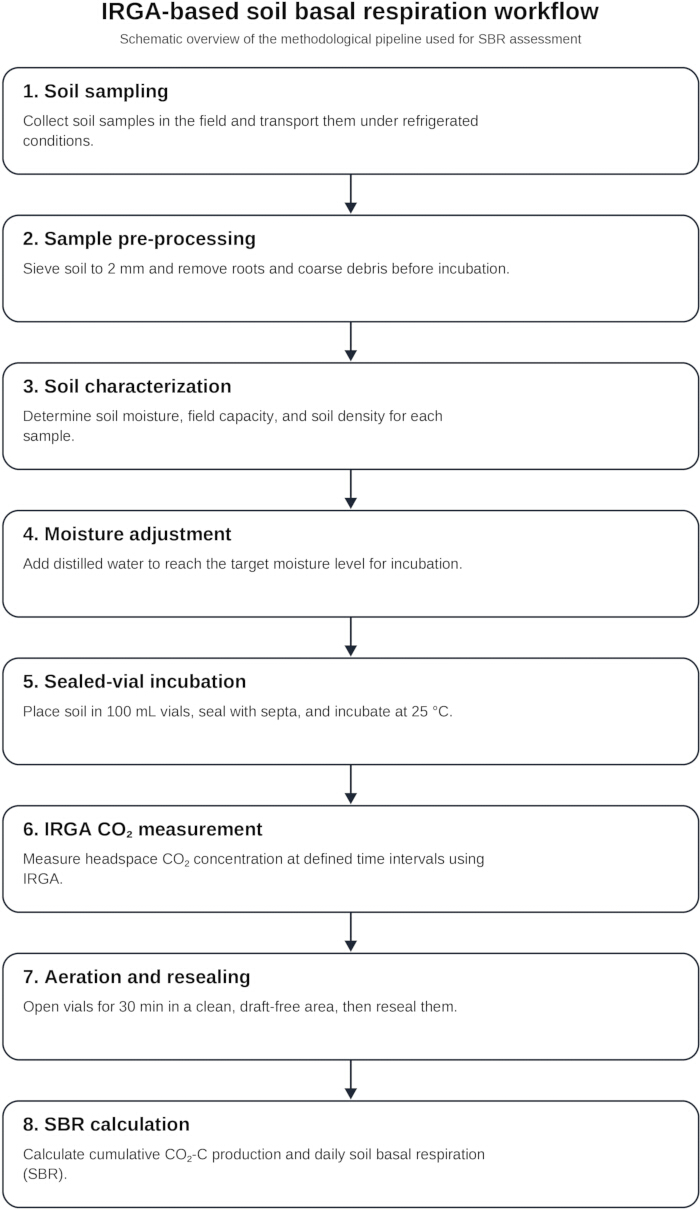
Figure 1: Workflow of the IRGA-based soil basal respiration protocol, from soil sampling and preconditioning to incubation, IRGA measurement, and calculations. Please click here to view a larger version of this figure.
Access restricted. Please log in or start a trial to view this content.
Results
Loading...
$$\rightleftharpoonup{xx}$$
$$\longleftharp{xx}$$,
$$\longrightharp{xx}$$,
The results showed in this article correspond to one experiment where low fertile soils were amended with compost to increase the fertilty parameters and microbiological activity. The original soils were surveyed at the “Tabernas desert” (Southeastern Spain), a region with a semiarid climate and poor developed soils22. Approximately, 40 kg of the upper 30 cm of one agricultural field were sampled, taken to the laboratory and 2 mm sieved to obtain the fine earth fraction. This was distributed in 6 ...
Access restricted. Please log in or start a trial to view this content.
Discussion
Loading...
$$\rightleftharpoonup{xx}$$
$$\longleftharp{xx}$$,
$$\longrightharp{xx}$$,
Soil respiration is a sensitive indicator of microbial activity and organic matter decomposition, providing noteworthy information on the effects of soil management 23,24. The experimental approach described in this article provides a simple and powerful framework to quantify soil microbial activity through CO₂ emission measurements under controlled laboratory conditions25, and it was based and updated from García et al. (2003)<...
Access restricted. Please log in or start a trial to view this content.
Disclosures
Loading...
$$\rightleftharpoonup{xx}$$
$$\longleftharp{xx}$$,
$$\longrightharp{xx}$$,
The authors have no conflicts of interest to disclose.
Acknowledgements
Loading...
$$\rightleftharpoonup{xx}$$
$$\longleftharp{xx}$$,
$$\longrightharp{xx}$$,
Authors are thankful to the following projects: UAL Teaching innovation project 25_26_1_85C; TECHBIOSOL (PID2024-156189OB-I00 funded by MICIU/AEI/10.13039/501100011033 /FEDER,UE) and FIRESOIL (CNS2023-145150 Spanish Next Generation EU/PRTR program funded by MCINU/AEI/ 10.13039/501100011033). Rocío Soria thanks her postdoctoral contract JDC2023–052350-I funded by MCINU/AEI 0.13039/501100011033 and FSE+. The authors thank to “Andaluza de Recuperación y Compostaje S.L” for providing the soil samples and compost used in this study.
Access restricted. Please log in or start a trial to view this content.
Materials
| Name | Company | Catalog Number | Comments |
|---|---|---|---|
| 2 mm sieve | |||
| Airtight flasks or vials with septa (100 mL) | |||
| Analytical Balance | |||
| Bar pressure plate extractor | Soil Moisture Equipment Corp, Goleta, CA, USA | 1600F1 | To calculate field capacity |
| Deionised water or distiller water sterilized | |||
| Incubator equipment | VWR Inc. Radnor, PA, USA | IL 250R PREMIUM | |
| Indelible marker | |||
| IRGA CO2 concentration meter | Ametek Inc. Berwin, PA, USA | CheckMate 4 | https://www.ametekmocon.com/products/headspacemapgasanalyzers/checkmate-4 |
| Isothermal bags and box | To tranport soils to laboratory | ||
| Laboratory Oven | It must permit a set of 105ºC | ||
| Laminar flux chamber | CRUMA | HZ-1 | Optional in step 2.3 |
| Septum stopper to seal vials tightly | |||
| Soil samples | Collected in a representative manner from the area to be studied. | ||
| Sterilizing reagents | bleach (10%) or ethanol (70%) can be used |
Reprints and Permissions
Request permission to reuse the text or figures of this JoVE article
Request Permission